
The 3-Step Financial Reset for my overthinking friends, who feel stuck knowing which way to turn with their money tasks.
Why This Matters (A Quick Story)
Yesterday, I had to complete my French visa renewal process.
It was the final day.
It’s not my first time doing it.
And yet…
I found myself cleaning out kitchen cupboards instead.
Classic avoidance. Normally I end up in floods of frustrated tears and give myself a migraine, so it’s no wonder really that I was avoiding it!
Eventually, I gave myself a proper talking to, sat down, opened my checklist, and just worked through it step by step.
No overthinking. No spiralling. I gave myself all the time I needed, 4 cups of tea and my reward was a glass of Saint Emilion 🍷
Simplifying into snackable tasks. Do this → do this → do this.
And it worked.
That’s exactly what we’re going to create for your finances. If you’d rather watch the video here’s the link and please do download the guide so that you can follow along:
https://budgetingandplanning.co.uk/free-budgeting-resources/
Firstly the 3 areas to get your head in the game – the most important part of the unsticking process.
🌱 Step 1. Decide Your Financial Priorities (and quiet the mental noise)
If you’re anything like me, your brain might sound a bit like this:
- “I should probably be investing…”
- “I haven’t sorted my pension…”
- “Do I need a will?”
- “What did I even spend last week?”
It’s constant. And exhausting. So the first step is to get everything out of your head and into something structured.
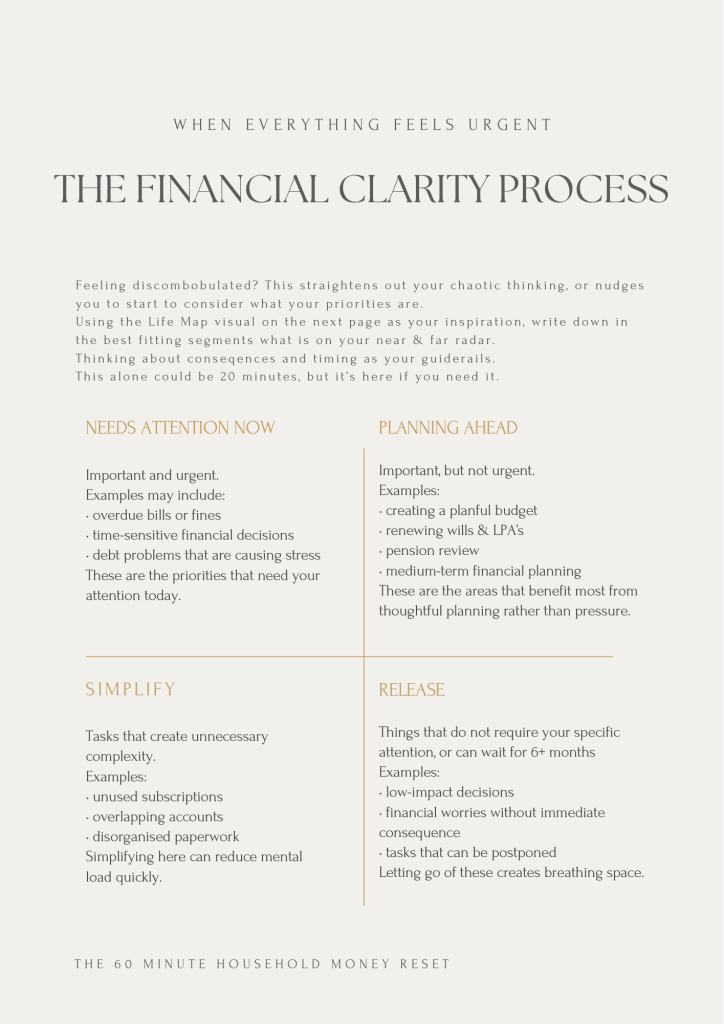
Try this: The 4-Quadrant Reset
Divide a page into four sections: or use this free Reset Guide: https://budgetingandplanning.co.uk/free-budgeting-resources/
1. Needs Attention Now
Things that genuinely need action this week.
2. Planning Ahead
Important, but not urgent (next few months).
3. Simplify
Things that feel complicated but could be broken down.
4. Release
Things that can wait, be delegated, or removed entirely.
This alone can reduce a huge amount of mental pressure.
🌿 Step 2. Layer Your Finances
One of the biggest challenges with money is this; there are so many things you could be doing. And you feel guilty that you’ve not done any of them.
Investing. Saving. Budgeting. Insurance. Pensions. Debt. Mortgage. Car Finance…
It’s noisy. So instead of trying to do everything, or doing nothing because it’s all too much, how about this:
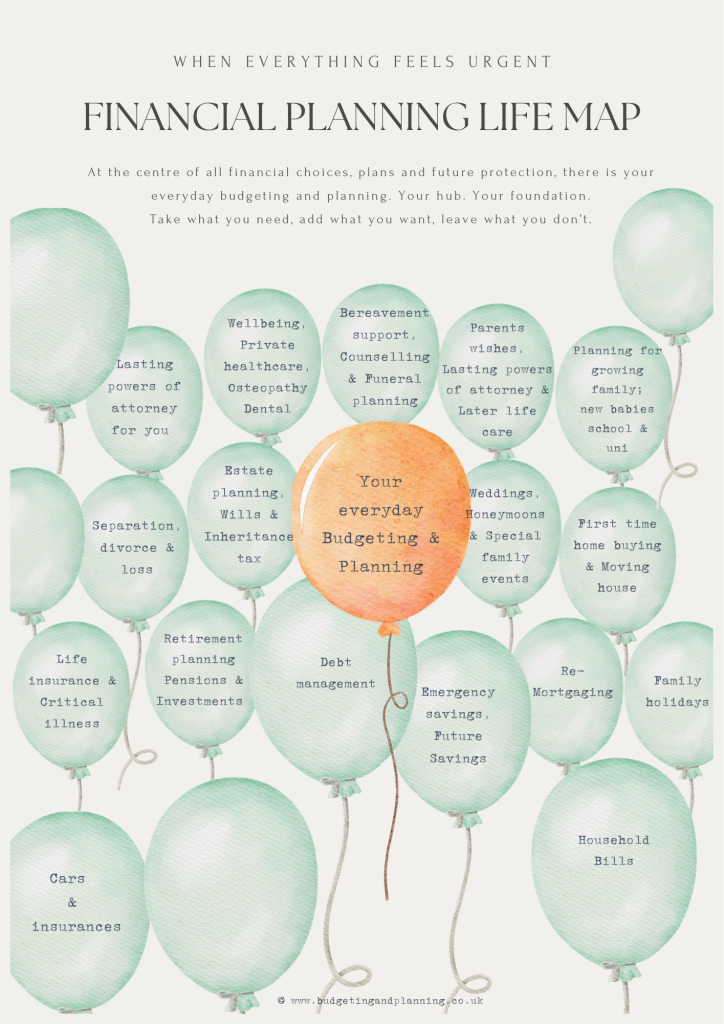
👉 Create a central hub.
Your core focus should be:
Your everyday budgeting and planning. This is your foundation. When this is clear:
• everything else feels less urgent
• decisions become easier
• the noise quietens
Think of everything else like balloons. You bring one down, deal with it, then let it float away again. You don’t need to hold everything at once.
Layer this into the clarity process so it’s completely personalised to you. Can you feel that fog starting to lift?
🌼 A Gentle Reframe: Values Over Goals
Traditional financial advice often focuses on goals.
But goals can feel rigid. Instead, try asking:
👉 What actually matters to me?
For example:
- Do I want to nourish my home & garden this year?
- Do I want to protect my family from life’s What If’s better?
- If we teamed up to throw all we can at our debt this year, how much lighter will we feel by next Spring?
- We need to nurture our relationship so we will have monthly money breakfast dates ☕️ and make lovely lifestyle plans together.
That feels very different to “Sort out life insurance.” Same action. Very different emotional energy.
🌱 Step 3. Create a Simple Financial Routine
This is where everything starts to stick. Because without structure your new routine will quickly fade.
Choose your space
For me, it’s the kitchen table:
• laptop
• paperwork
• a coffee
• maybe a candle and probably some lovely music in the background.
Nothing fancy just a space where I can think clearly, have enough room for any paperwork, diary and large calendar and so it feels like I’m actually taking care of things. It’s not squished into other duties, I’m not doing 3 things at once, it’s peaceful and it feels good.
Keep it simple
The biggest barrier for overthinkers isn’t ability.
It’s faffing. You know it is!!!!
Over-preparing. Over-tweaking. Over-delaying. Or being so unprepared & disorganised that just the thought of getting your things together is all too much before you’ve even started.
So instead:
👉 Set a regular rhythm
Weekly, monthly, or seasonal
👉 Gather what you need. Think like a chef on tv who has all the ingredients in gorgeous dishes just waiting to be used.
👉 Work through your process. When it’s written, you don’t need to think. Each task has a checkbox ✅
Done.
If you’ve got the guide downloaded you can move to using that, or see a short version below.
🌿 The Detailed Get It Done Process Now You’re Unstuck With What To Do & When
Here’s a simple structure you can follow for a fresh start. This is brilliantly repeatable each month. Add your own priorities.
1. Gather Your Numbers
Bring together:
• bank accounts
• credit cards
• savings
The first time may feel messy, that’s normal. You’re not fixing everything. You’re just seeing clearly.
2. Take an Honest Spending Snapshot
Look at:
• where your money is actually going
• not where you think it’s going
You might feel:
• pleased
• neutral
• slightly horrified
All completely normal. This is information not judgement. For goodness sake do NOT go down the rabbit hole of guilt, which is what you’ve DONE. And never go down to shame, which is how you identify your relationship with money. What’s done is done, you are becoming the kind of person who has their financial resources working well.
3. Capture Forgotten Expenses
Those “surprise” costs? They’re often just forgotten ones.
Add things into your calendar like:
• annual bills; car servicing, dentists.
• seasonal spending so your garden gets as much love as Christmas, kids after school clubs & new clothes.
• renewals so you’re not getting stung on the rollover policies.
This reduces future stress massively.
4. Reset Your Relationship with Credit
Key Q to find the answer to:
• How am I using credit?
• Is it intentional?
• Is it helping or just happening?
Again, no judgement, just awareness. How do you feel about this? What would you like to be different?
Final Thought
If your finances feel disorganised or stressful…
It’s rarely because you’re bad with money. This isn’t about you as a person, this is about your systems, your process, your habits & routines. These can all be changed. You’re a lovely person, trying your best.
🌿 Your Next Step
If you’d like to follow this process with the practical get it done elements, here’s the link again to download my free Money Reset Guide and work through it at your own pace.
And I’d love to know:
👉 What would you add to your reset?
👉 What feels most overwhelming right now?

With love from
Lucy x
ps. If you are an employer, or HR Manager and would love financial wellbeing education for your team, I freelance with Finwell Training LTD and we would be delighted to welcome you along for a complimentary live masterclass so that you can experience it.
https://www.finwell.training/budgetingandplanning


0 Comments