
The Room Where Nobody Wanted More
“What would enough look like for you for the rest of 2026?”
Dozens of pairs of eyes upon reading this, would have looked up & right, pen tapping the corners of mouths whilst thinking about life this year thus far, and what would feel good for the next 7 months.
I’m a member of a community business group is full of brilliant minds, creative talent & genuinely honest support. A rarity. Over the course of the day, dozens answered this question in our online community.****
I shall paraphrase all of them into one:
“I want to be able to pay the bills, feel steady, know my family is healthy & happy, that my work matters, and we can enjoy our homes. Maybe a little holiday too…”
We all wrote a version of wanting peace. Not 6-figure months.
Tranquility.
Safety.
Why? Have we lost our ambitions for growing successful businesses? Is this even normal?
The Mental Health Reality
Edging towards 50 we start to want different things, of course we do! Each decade can be defined in your life as an era where you … and the latter part of each invariably moves us towards the next season.
What was interesting to me, is that a lot of my community colleagues are in their 30’s, and it seems like the universal desire is to feel calm & content. Not to shrink away, not to live in a bubble of invisibility, but to have a softness in life that creates a gentle daily energy. Finding joy in small things again, appreciating nature, art, morning coffee in the garden, home cooked food, clothes that fit well & made of natural fabrics and last year in and year out. A sensation of nostalgia sweetly reminding us of simpler times.
62% of UK consumers say the economy is worsening. 70% are experiencing financial stress weekly. The ONS savings ratio is at near-historic highs, not because people have more, but because they’re gripping tighter. The data that shows this isn’t a personal failure, it’s a collective, rational response to a genuinely difficult environment.*
Research from Confused.com surveying UK adults going into 2026 found that financial stability not wealth, not financial freedom is the number one goal, cited by 58% of UK adults. It ranked above travel, homeownership and every other aspiration on the list. RSM UK **

Hope and Shame: The Two Invisible Forces
According to the Cigna Healthcare International Health Study 2025, 70% of UK adults report experiencing stress primarily due to financial strain on a weekly basis.”
University of Southampton research found something striking about what sits between financial hardship and mental health outcomes. Hope mediated the relationship between subjective financial hardship and depression, stress and wellbeing.
Shame mediated the relationship between financial hardship and anxiety. Neither operated on the same symptoms. Hope and shame were doing different, distinct psychological work. nih This is profound: people struggling with money aren’t just worried, half of them are ashamed.
How do you feel?
I’ve spoken with clients who feel this way, who say they made in hindsight, risky financial decisions 10+ years ago, not really considering the impact if the economy changed. And now, they’re in trouble. Upsizing their homes, very normal as your family expands, but when you’ve got a £1000 a month mortgage that has now doubled and then some over the course of a few fixed rate cycles, it can make everything more than difficult.
New cars every 4 years as never ending expenses. Paying for holidays & Christmas on credit cards. Habits that feel like normal life can be emotionally tough to change.
Gone are the days of expecting your kids to share a room. No one imagined 25 years ago that each child would have TV’s and computers, £1000 iPhones & endless snacks on repeat. Both parents exhausted working full time. Our expectations of a nice lifestyle has overtaken the ability to fund it. And it stings. Especially if you’ve been used to it and now, things have to change.
One in three people said worries about being able to afford to pay bills made them anxious in the last two weeks. Mental Health Foundation
I sincerely hope this is not where you’re at? There is a wonderful array of support available. Step Change is one and Mind is another. You’re not alone, ever.
What You Actually Want (And Why That’s Enough)
Bills paid. Food on the table. A small family holiday. Sleep. Next few months covered. Things the kids need. Slower pace.
The psychology of sufficiency is not a lowered bar, it’s actually where genuine wellbeing lives. ***
Can we put a price on this?
Having one month’s income in savings reduces the odds of falling behind on bills by nearly 75%. Office for National Statistics
Enoughness as a radical, intelligent choice is worthy of a good old fashioned debate doncha think? Get your perspectives in the comments my friend.
And if you need something lighthearted to watch, how about The Good Life? A classic british comedy based on the courage to change from the suburban rat race to becoming self sufficient. The observation between Margot & Jerry, Tom & Barbara is wonderful, comfort TV even if you’d never consider in a million years having a smallholding in your garden or wear old jumpers with holes in.
Ironically, we probably know more than one eccentric very wealthy person who wears clothes like this, patches on patches.
The One Thing That Changes Everything
Control. Having agency over your own finances & choices. Not wealth, not financial freedom, the felt sense of knowing where you stand. Perceived control over your household finances is the single biggest predictor of financial wellbeing. Having a plan isn’t just a spreadsheet. It’s a nervous system intervention designed to work with your spending psychology day in and day out.
It’s having your expectations matching your reality. It’s still having dreams & aspirations, but it’s also learning to love what you have with a grateful heart and not feel that desperate pull for more. I learned & try to practice the approach that, there are thousands of gorgeous things to buy. Endless home styling & clothing inspiration on Pinterest. I can look, I can appreciate, I can get ideas but I don’t need to buy it.
When the shit hits the fan, yours and your family’s health is all that matters. When you’ve been on the brink of losing a loved one, you find an energetic tunnel vision like you’ve never experienced. You’d give up everything materially to make them better. Steve Jobs famously said “Death is life’s biggest change agent” (slightly paraphrased)
In fact, so powerful is this speech, I’m going to link it here for you to watch:
What now? Here’s How I Can Help
As your fairy godmother of household finances we can get all the practical elements of your day to day, quarter to quarter spending running like clockwork. We can figure out ways for you to be more economical, buying less but better and have a simple system that you will use to keep your control even in the face of adversity.
It doesn’t have to be a tight grip so you can’t breathe. In fact, I’d say it shouldn’t be. But your own flexible, budgeting system that ebbs & flows with your life is a skill you will never not use again. (Double negative, but it works)
Creating comfort, easy, steadiness will help you sleep at night. It won’t necessarily mean huge shifts in your lifestyle or going without, but perhaps there will be need for compromising.
I’ve a longer piece on this topic that you might like to read on Substack:
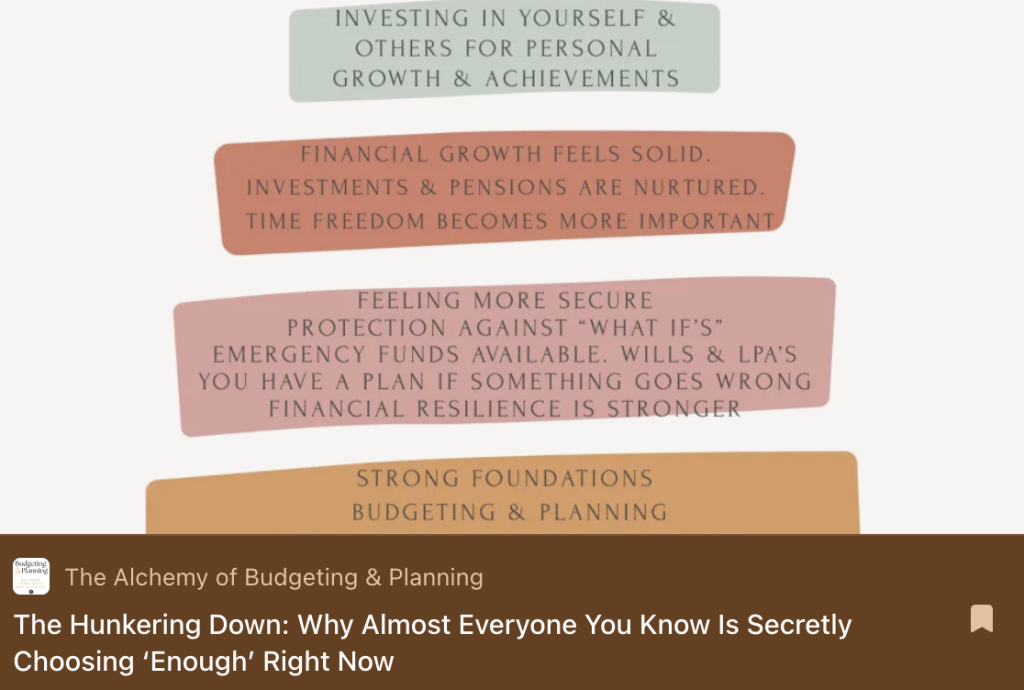
I’ll finish on this note. Building wealth, investing for your retirement will feel inspiring not impossible when you’re feeling steady. Trust me when I say that, as you skid into your 50’s you’ll want to feel like you’re in good shape for the next decade and beyond. You might even want to buy a house in France to semi retire to…
I know someone that can help you out with that – more on that another time.
So, do tell me in the comments, what is enough for you for the rest of the year?
Until next time
Lucy x
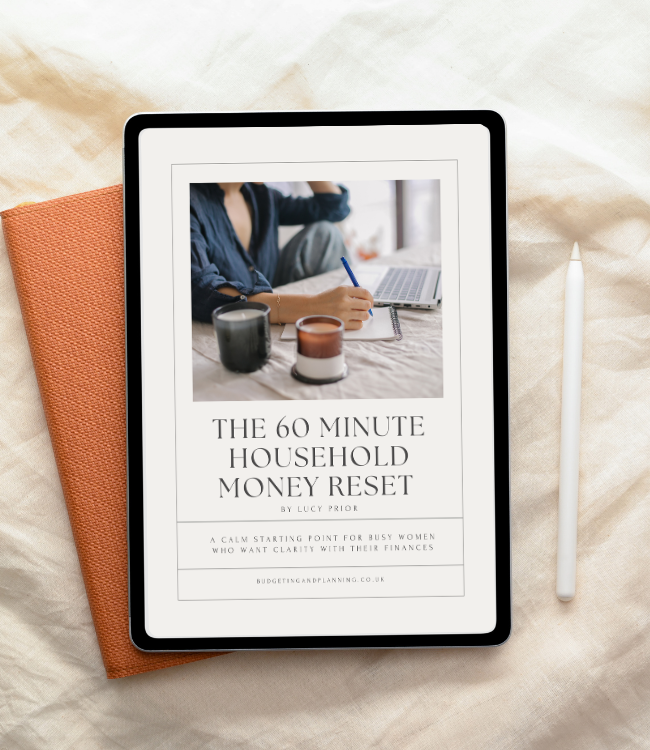
You can get my fortnightly emails with links to the latest blog, free eGuides & more here:
https://budgetingandplanning.co.uk/free-budgeting-resources/
**GfK (now part of NielsenIQ) has been running the UK Consumer Confidence Barometer every single month since 1974, which makes it one of the most reliable long-term measures of how British households are actually feeling. The score runs between -100 and +100. We haven’t been in positive territory for a decade.
Source: GfK Consumer Confidence Barometer powered by NIM.
The official monthly releases live at the NielsenIQ site — the April 2026 report is here:
https://nielseniq.com/global/en/news-center
The House of Commons Library also tracks it cleanly and is a highly credible source
https://commonslibrary.parliament.uk/research-briefings/sn02817/
**Source: Confused.com, January 2026 Link: https://www.confused.com/press/releases/2026/3-in-5-brits-put-financial-security-at-the-top-of-their-2026-goals
*** Source: Confused.com Life Insurance, January 2026 The precise stat: 58% of UK adults prioritise financial stability as their number one goal — above travelling abroad (54%) and owning a home (35%). Link: https://www.confused.com/press/releases/2026/3-in-5-brits-put-financial-security-at-the-top-of-their-2026-goals RSM UK
****


0 Comments