How about a calm, affordable & gorgeous Christmas this year?
The way you spend Christmas is far more important, than how much.
(Henry David Thoreau)
Lisa is a busy, creative mum of two who always means to plan ahead, but somehow… doesn’t. She isn’t “bad with money”; she just feels totally overwhelmed. Christmas sneaks up on her every year, it’s too bloody close to Halloween and Bonfire Night. She’s caught in a swirl of school plays, secret Santas, works Christmas do’s and last-minute panic buys.
She tells herself, “It’s fine, I’ll sort it next year, let’s just get through this one.” Knowing full well that throwing money at the problem is not only unsustainable but infuriatingly wasteful. Her flexible friend wasn’t being so flexible these days.
She came across a friend of a friend one day over a coffee, who specialised in being organised. She listened to Lisa and how she bounced from one thing to the next, in an almost relentless chaos. She didn’t lecture her or make her feel even more guilty. In fact, she listened, understood her frustrations and spoke her language about wanting the slow, comfy Christmas she’d had as a child that was full of magic and fun.
But how? How was it possible to create a Christmas film kind of Christmas? Cookies in the oven and hot chocolate on tap?
What did Lisa want?
To be wearing sparkles, tying velvet ribbons on the tree and placing trays of nibbles next to glasses of fizz. She could see the fairy lights it in her mind’s eye, she described to her friend how she could smell the mulled wine spiciness on the hob, hear the woodburner crackling it’s comforting warmth and knew with every fibre of her being, she was not going to be squiffy and sobbing at 2am on Christmas day frantically still wrapping presents – again!
This friend was completely realistic about how life actually works. It helped Lisa see that planning wasn’t about creating Instagram perfection, it was about creating peace. And oh dear god, did she need some peace!
Afterwards, Lisa could easily visualize what she wanted to create. She planned in when she was going to do things. Give or take a few days, but you know, that same week at least. Like; making a door wreath from her dried hydrangeas and foraged greenery, chutneys and chilli jams from her nurtured tomatoes before they started to smoosh. As for a Christmas cake, her family always laughed when she said she’d make one, as they always found the M&S box in the recycling bin.
It was only really Lisa who cared about all of these things. She put a lot of pressure on herself to craft the perfect festive season, then would berate herself for having to buy everything in. She hated going into her overdraft for the sake of a few days, but was also determined that her smallies, husband and extended family would have the best time. She’d forgotten she should be included in that.
An energetic shift
Later that week, Lisa could feel her energy shifting around the early seasonal buildup. She started to get that cosy feeling she’d longed for. This plan of hers was already having a calming impact on her nervous system and her budget; it felt like a breath of fresh air.
In the first week of October, she reviewed who she was likely buying for, set soft spending limits, and layered these into her planned spending. (She hated the word budget so Planned Spending became her mantra)
To keep herself accountable, organised and on track instead of winging it or getting distracted, she took 30 minutes every Sunday with a cup of tea, her notebook, and her own real-life numbers. She simply checked things off her list, and if she overspent somewhere, she decided how to underspend slightly elsewhere to make up for it.
She was becoming that kind of woman
What amazed her, not being the most natural of planners, was how easy it was. How quickly she could do the boring stuff. Right after her Sunday morning check-in sessions she’d have all the feels and went on to make Christmas fudge, homemade hand scrubs, winter floral displays, and wrap them as little extras for her friends. Yes, she was becoming that woman. The one who had something sweet and thoughtful to take to Christmas parties for the hosts as well as a bottle of plonk.
Getting her family on board with the planning, wasn’t as hard as she expected. They never wanted her to be so overwrought, they loved watching her in her creative element and they were excited to be involved in the whole process.
This January 2025, she didn’t dread their bank statement. Nothing was chucked onto their credit card. There were no late-night Amazon regrets. No hiding receipts. No guilt.
Lisa said, “For the first time ever, I actually enjoyed Christmas. I gave (and received) gifts that were loved, rather than ‘that’ll do,’.
And I didn’t need a financial detox in January. In fact, I saved £200, especially so I could treat myself in the sales afterwards. Something I could never do before”
So, who was this friend, and what was this alchemy?
A one-on-one lovely mentoring session that gave Lisa everything she needed to feel energised and inspired and best of all, looking forward to this cosy season with her family, with no debt on the other side.
Tell me in the comments, are you a planner, or do you skid into the house on Christmas Eve knowing you’re not getting any sleep until Boxing Day?
Let’s explore one of those emotional layers in reality:
The desire for more. The desire for a lifestyle that isn’t yours (yet)
Spending for Belonging
Buying stuff so you feel like you belong to a life you don’t (yet) have. With those friends. With that group of people. To that aesthetic lifestyle, the ones you watch for hours on socials.
They’re my comfort TV and my inspiration. If I didn’t already live rurally, I’d be hankering after country life. I would want all the fleece gilets money could buy.
Their lives look like utter perfection.
But here’s the thing: I can’t buy what they’ve created. Sure, I could buy some of the stuff, but it takes more than things to create a lifestyle. And who’s to say it would bring me much happiness as I think it would?
What Have They Created That I Love So Much?
Homes:
They’ve built beautiful homes over many years. We’re renovating ours now, sourcing furniture at brocantes and bric-a-brac fairs, layering in with what we already own. It’s dusty and imperfect, but we’re getting there.
We love similar soothing colour palettes. Neat, clean and organised is in my DNA.
I am a cushion fanatic, I love making my home feel cosy. And we are having fun creating everything. Albeit on a considerably smaller budget.
It’s amazing what a tin of paint can do, decluttering and lamps. No big lights are ever turned on around here. My eye bags cannot handle them.
When I watch these two gorgeous women, I see how happy they are, how their homes are their sanctuaries and how so much love fills their lives. Is this what you’re missing or is a new sofa intrinsic to your happiness? Hey I’m not judging, I had my two old ones 25 years and have just bought my first ever “grown up” sofas. The change in comfort and style is immense.
(image of my fancy new sofa and cosy cushions)
Gardens:
Their gardens are breathtaking, though supported by a team of gardeners (which I only recently realised, duh!). Our dream garden is tiny by comparison and is being crafted out of sweat, blood, and a few tears. It’s not Instagram-ready, but it’s ours, and patience is the greatest lesson it’s teaching me. Why won’t it grow already?! I can, however, waft around with a cup of tea and my secateurs, snipping and clipping, so I am already in my element even if the photos aren’t pretty, yet.
Personal Style:
They look flawless in their gorgeous home gyms with personal trainers and perfect activewear. Me? My “gym” is the creaky sun lounge where I fling myself around to Fitness+ dance workouts in my PE kit, much to the amusement of the neighbouring farmer.
But style isn’t about spending more. I don’t need the fancy gym gear, there is no amount of lulu lemon that will make me look good in leggings.
Style for me, is about choosing better to begin with. The older you get, the more you want one nice thing over 5 cheap things. I’m also looking forward to rediscovering what I already own (once I unpack those moving boxes) and using my wheeled clothes rail to create outfits, an actual capsule wardrobe. It’s so easy, when working from home to look more shabby than chic and I want to change that.
I find watching their videos really helpful in trying something new.
And not to forget, sewing on missing buttons, de-fluffing knitwear, polishing boots & bags, and actually ironing clothes make a startling difference, who knew?
Comparison vs Inspiration
When I look back, I realise I’d already created what I wanted in my 30s, buying my little farmer’s cottage solo. Now, in France, we’re building a new version of our dream. Living simply is luxurious to us now. The nearby donkey braying and the responding howling of our neighbours’ hilarious spaniel are our alarm clocks.
Comparison is the thief of joy. And yes, I feel it creep in more often than I’d like. But I actively choose inspiration instead.
Your thoughts can be changed. You are not your thoughts.
If you’re feeling “less than” when you compare yourself to someone online, is it true? Of course not. You may have less stuff, but you are not less. Self worth and money is a huge topic.
What, really, when you dig into it, is most meaningful for you?
Why Wanting Feels Better Than Having
Psychology explains why that “wanting” can feel more intoxicating than “having”:
Dopamine spikes in the chase, not the catch. Anticipation lights up the brain more than ownership.
Scarcity makes things sparkle. Out-of-reach feels like treasure. Once owned, it can often lose some of its magic.
Fantasy vs reality. We imagine the item will change our lives. Reality rarely matches fantasy.
Adaptation kicks in. Humans adjust quickly; that new bag or car soon blends into daily life. And then you want something else.
Lifestyle Creep = you get a pay rise, you buy more. You barely notice that extra £5k a year, your life is just the same as it was. Are you happier? Or still feeling like you’re living month to month?
This is why buying to fill an emotional gap leaves us flat once the buzz fades.
Appreciating luxury, art, beautiful homes & gardens is one of life’s many pleasures. Recreating your version at home is a wonderful way to spend your time and money. But don’t go broke trying to have it all. You don’t need it. At least, not in order to belong or feel more loved.
(picture of my comforting flapjacks – also look pretty on the table. I’m reusing a cheese board set that we were gifted!)
Redefining Luxury
Can I afford luxury? Not in the designer sense. But luxury doesn’t have to mean “out of reach.”
For me, it’s quality, longevity, and love.
A £100 candle? Gorgeous, but pointless if I’d never light it. Essential oils mixed together can recreate a similar effect and your friends will still tell you how they love how your home smells. Nice church candles give the visual effect you’re after.
Pre-loved, second-hand, charity shop finds? That’s my kind of luxury. Affordable, sustainable, creative. Call them antiques if it makes you feel better.
Real luxury for me is…
Decanting pantry goods into pretty jars and cooking good food for my family and friends to enjoy together. Setting the table nicely and taking pictures so that I can remember a regular Tuesday in years to come.
Re-waxing my old Barbour and washing the mud off my decade-old wellies. Applying lipstick and perfume daily. Using the nice glasses and having good coffee. Looking after what I’ve got and been gifted over the years.
The smell of homemade cake filling my kitchen, and then peacefully reading a book whilst eating a slab.
A playlist I love, creating the mood I want and feeling like my pace of life brings me more happiness than it does stress.
Not worrying endlessly about money. This means facing it head-on. Planning ahead as much as humanly possible so nothing becomes troublesome. Decisions can be mulled over, not rushed.
If I want to buy something lovely, I know I can. The freedom to choose.
Luxury is about your sensory feelings, not spending.
Creating Your Own Belonging
Ask yourself: what do you love most about the creators you follow? What are you really longing for that you don’t have, and how can you create a version that suits your lifestyle and budget?
Your life isn’t smaller than theirs. Your worth isn’t less than theirs.
But if watching them leaves you feeling crap, stop watching. Focus on your own life and being present in each moment. Spend that time tweaking an area at home that you hate so you can look at it with pleasure.
The Real Belonging
True luxury, true belonging, is simple:
Good times. You co-create your life every day. Are you enjoying it?
Good health. Nourishment for your body and soul. Peace of mind.
Having people, books, music and a home you love (or you’re working on loving)
And that, my friend, is worth more than all the fleece gilets in the world.
If you need someone to talk to about unravelling where your head is at, you’re most welcome to book a 20 minute free consultation.
If you feel yourself leaning in to how we chat and want more, you can book an hours mentoring session to sort out your unruly finances and find some peace with your thinking.
Not financial advice, but organisation, clarity of direction, a spending plan set up and a lot of new perspectives.
How mentoring will soothe your frazzled nerves
Trying to do anything complex and new on your own is part of life. The frustration can kick in fast and stay for a long time.
When you have a really good guide, you’ll do it all faster, better and even if it does get emotional, it’s short lived.
What we do with every choice we make, every day, every month, every year, is driven by our thoughts.
Emotional financial layers – inspired by Cognitive Behavioural Therapy
Are your thoughts helpful & inspiring to you? Do you create plans that excite you?
Or do you say f*** it I’m too tired, too stressed, too busy, too scared to do anything differently?
What you think creates your feelings. You might know this cognitive behavioural process already? If not, read on…
So if what you’re thinking about money, stems from your beliefs about it, it’s likely this comes from what you do with it regularly and that’s because of how you feel.
★ Let’s take an example of not looking frequently at your bank account.
If you feel scared to look at it because of the chaos you might see, you won’t want to look at it at all. Looking at it will make you believe you’re crap with money and so you’ll think you need to have an entire financial overhaul; which is making you feel really stressed, so you do nothing, and then you believe that you’re in financial trouble ….
But the reverse is also true. Thinking gentle thoughts will create gentle feelings…
Do you feel peaceful, secure, hopeful? Perhaps a little cautious? (this is normal!)
The economy will always be uncertain. We can only control our home economics. (this is one of mine)
Do you feel good about your decisions or are you making them willy nilly with little regard to how you really feel? Are you doing things out of habit because you haven’t got time to make different decisions, to think differently, to feel differently?
Do you feel all over the place? Chaotic & disorganised, perhaps being carried along by some unknown force in the shape of kids, work, life and you can’t seem to stop? What you feel drives what you decide to do, or not do.
What you do creates your results.
What are your results every month, every quarter, every year? What are you working towards? What lights you up?
Do you cross your fingers & look one eyed at your banking app? Or do you take action every month to ensure all is as it should be? Your results create your beliefs that you carry into next month, next quarter, next year.
What are your beliefs about money?
I’m good with money / I’m bad with money / money is stressful.
Your beliefs are your compass. They show you where you go. How comfortable you are with risk, uncertainty and the inevitables changes in life?
Do you believe money is purely a vehicle to exchange for goods & services?
How DEEP do your feelings run when it comes to money? This is a topic that can’t be finished in one blog. It’s huge. But you can start to create your personal picture. Start to understand yourself better.
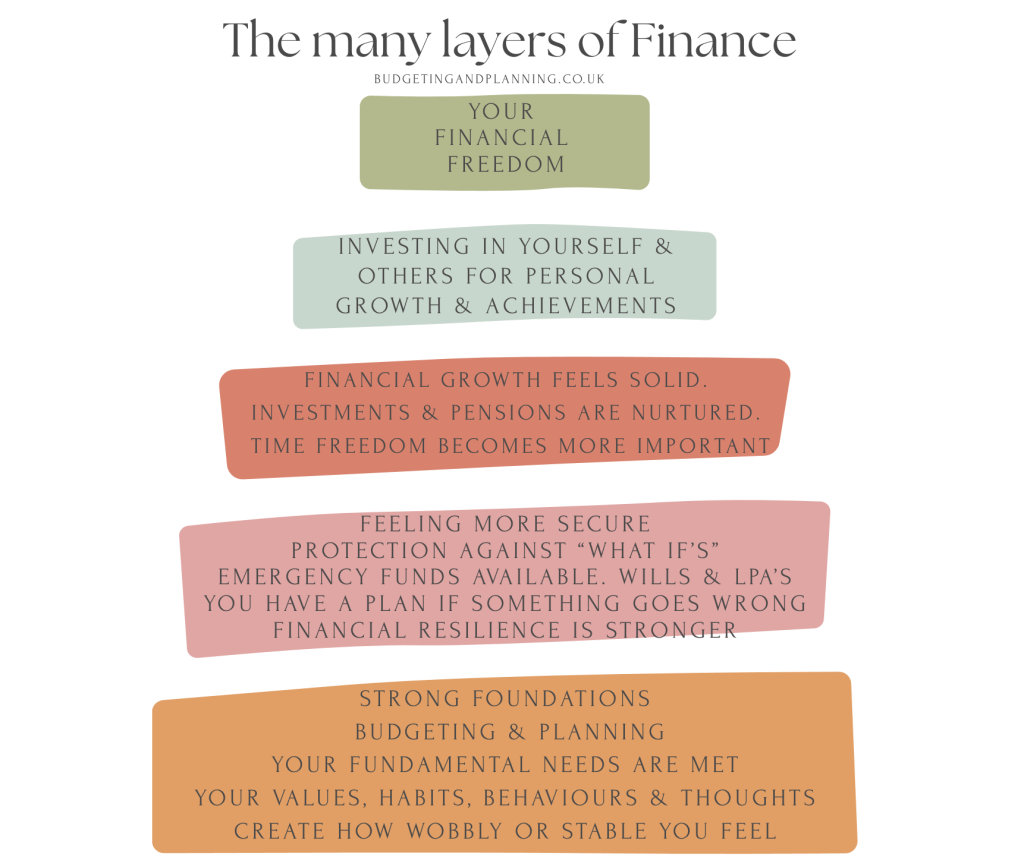
Let’s take a look at my version of Maslow’s hierarchy of needs:
For me, for years, it was fear that was my root emotion when it came to my finances.
Fear that I wouldn’t have enough. That I would be in danger if I didn’t have enough. My safety would be compromised. I’d lose my home. But I’d always counteract that with the belief that, all the while I could move and talk, I would always earn it even if it meant I would work 100 hours a week.
I’m a grafter. And I like to feel safe. I’m currently in the financial growth stage but I still need to nurture my pension pots, collate them into one for much better returns. And I need a new will and LPA having got married last year and moved from the UK to France.
What about you?
For many people, shame features highly. Guilt and a lack of self worth circle around one another. This topic can go deeeeeeep. This is but one article of many, and we will continue to explore this. Gently and peacefully.
Creating a healthier relationship with money will change your life.
You might always be a bit of a worrier, I am! But holistically, having more positive thoughts will create much better decisions.
There are many nuances around our feelings and these can be rooted in our past, present or a likely future seasonal shift.
Be that a death, a desertion, a divorce. Moving homes, jobs, having kids, redundancies and promotions. Or simply greeting a new decade with fresh eyes and desires.
Financial and emotional resilience can be hard. But, if you could learn how to protect yourself a little bit better, improve your knowledge and have a bit of a plan, you’d have a cushion. A softer landing.
A softer landing with your finances, means you can allow yourself to heal emotionally without the added drama of worrying about money.
Practical financial layers made easy
Let’s take a look at my version of the layers of financial services in a digestible way. Pairing this with the hierarchy of needs image and how you feel will provide you with something tangible especially if you’re really muddled about it all.
🍞 Bread & Butter (or buppy as my mum calls it 😁 ); Budgeting to make the most of your earnings, saving for lovely things, paying the bills, caring for your growing family and keeping your home as your sanctuary.
🍷 Borrowing; Mortgages, loans, overdrafts, credit cards. Handy in moderation, but too much and it’s like watching bambi on ice
🧂 Growing & Investing; Pensions, ISAs, Investments. They add flavour to the dish of life + preserve and grow your money for decades
🛟 Protection for you and your loved ones; Insurances, wills, estate planning, lasting powers of attorney, emergency funds. Safety when you need an SOS
🍒 Optimisation; Tax efficiencies, strategically using your allowances and future planning
Financial advisors, mortgage experts and lawyers take care of all of those things with you. Don’t be afraid, they’re on your side.
As for me, I’m the Buppy Expert!
★Helping you get comfy planning and managing your money so it makes sense monthly > yearly. You’ll not get stuck in a loop so often. You’ll feel in control. You’ll feel your pressure gauge let out steam.
★We will see what’s going on with your spending & saving habits and try on some new ones for size. Freshen things up a bit.
★Curating a purpose, a direction that you love and feel inspired by. When your seasons shift, your money should be ready & waiting. Or at least, walks in step by your side.
★Crafting a cunning plan AKA a strategy to move you forwards. Calmly, simply and flexibly.
So, what now?
Have a think about how you feel. It might have changed recently.
Can you see how it is affecting your decisions?
What practical elements are missing from your life?
Need some help with a dollop or a sprinkle of emotional support?
How about some respectful, thoughtful and relatable mentoring?
As your guide, I’ll never tell you what to do or what financial products you need. You need a regulated professional for those.
I’ll ask you questions that will guide you to find your own answers that were there all along, just hiding.
I can signpost you to alternative support if needed
Ultimately we get to the root of your worries, and create a plan that moves you forwards. Life will always life so there is no perfection here. Just new life skills to learn.
We can create your entire flexi budget together
You can have 20’ish minutes on a free call to see if we’re the right combo to work together.
Used to determine whether a user is included in an A / B or Multivariate test.
18 months
_ga
ID used to identify users
2 years
_gali
Used by Google Analytics to determine which links on a page are being clicked
30 seconds
_ga_
ID used to identify users
2 years
_gid
ID used to identify users for 24 hours after last activity
24 hours
_gat
Used to monitor number of Google Analytics server requests when using Google Tag Manager
1 minute
_gac_
Contains information related to marketing campaigns of the user. These are shared with Google AdWords / Google Ads when the Google Ads and Google Analytics accounts are linked together.
90 days
__utma
ID used to identify users and sessions
2 years after last activity
__utmt
Used to monitor number of Google Analytics server requests
10 minutes
__utmb
Used to distinguish new sessions and visits. This cookie is set when the GA.js javascript library is loaded and there is no existing __utmb cookie. The cookie is updated every time data is sent to the Google Analytics server.
30 minutes after last activity
__utmc
Used only with old Urchin versions of Google Analytics and not with GA.js. Was used to distinguish between new sessions and visits at the end of a session.
End of session (browser)
__utmz
Contains information about the traffic source or campaign that directed user to the website. The cookie is set when the GA.js javascript is loaded and updated when data is sent to the Google Anaytics server
6 months after last activity
__utmv
Contains custom information set by the web developer via the _setCustomVar method in Google Analytics. This cookie is updated every time new data is sent to the Google Analytics server.
2 years after last activity
SourceBuster is used by WooCommerce for order attribution based on user source.
Name
Description
Duration
sbjs_session
The number of page views in this session and the current page path
30 minutes
sbjs_udata
Information about the visitor’s user agent, such as IP, the browser, and the device type
session
sbjs_first
Traffic origin information for the visitor’s first visit to your store (only applicable if the visitor returns before the session expires)
session
sbjs_current
Traffic origin information for the visitor’s current visit to your store
session
sbjs_first_add
Timestamp, referring URL, and entry page for your visitor’s first visit to your store (only applicable if the visitor returns before the session expires)
session
sbjs_current_add
Timestamp, referring URL, and entry page for your visitor’s current visit to your store
session
sbjs_migrations
Technical data to help with migrations between different versions of the tracking feature
session
Marketing cookies are used to follow visitors to websites. The intention is to show ads that are relevant and engaging to the individual user.
Pinterest Tag is a web analytics service that tracks and reports website traffic.
Registers a unique ID to keep statistics of what videos from YouTube the user has seen.
Session
DEVICE_INFO
Used to detect if the visitor has accepted the marketing category in the cookie banner. This cookie is necessary for GDPR-compliance of the website.
179 days
LOGIN_INFO
This cookie is used to play YouTube videos embedded on the website.
2 years
GPS
Registers a unique ID on mobile devices to enable tracking based on geographical GPS location.
1 day
VISITOR_INFO1_LIVE
Tries to estimate the users' bandwidth on pages with integrated YouTube videos. Also used for marketing
179 days
PREF
This cookie stores your preferences and other information, in particular preferred language, how many search results you wish to be shown on your page, and whether or not you wish to have Google’s SafeSearch filter turned on.







Recent Comments