You already know you need a budget. So why aren’t you doing it?

You already know you need a budget. So why aren’t you doing it?

The psychology behind the gap between knowing and doing & how to finally close it

Knowledge gap → learned helplessness

Without the knowledge of how to apply what we’ve read or heard, we disengage. Or get it wrong. And when we get it wrong or enter that whole new world of frustrated learner, it’s unlikely unless we’re super determined, that we’ll keep going with it.

For me it’s like following a recipe you’ve never seen before. If there’s no image & just basic instructions, it doesn’t really click until I watch someone actually make it or at least see some pictures of what it’s supposed to look like.

How, how do I fold in the cheese?

You just, you fold it in David!

It’s a recipe, the instructions are there, but Moira has absolutely no framework for translating the instruction into action. If you’ve never seen the series…. what are you waiting for?

The broader series arc is genuinely one of the most elegant depictions of identity reconstruction around money, ever put on television without it really being about money explicitly. In the same way that Ted Lasso isn’t really about football.

The Roses don’t just lose their wealth, they lose their entire self-concept that was built on it. What the series tracks is the slow, often painful, occasionally joyful process of finding out who you are when the financial identity is stripped away. Which maps directly onto everything I often discuss; present bias, identity, emotional reappraisal, & getting back to basics.

I love that it ended optimistically. They come out the other side with stronger identities, better relationships, and arguably more self-awareness than they started with. That’s a really hopeful message about money psychology, that financial disruption doesn’t have to be the end of the story.

Of your story.

Even if it feels that way at the time.


Anyway… back to knowing & doing.

The Science Bit

This is a well-trodden area in psychology and there are a few clean frameworks that explain it.

The core problem is that knowing lives in one part of the brain and doing lives in another, and they don’t automatically talk to each other.

Knowing is largely a prefrontal cortex function; rational, analytical, future-oriented.

Doing is driven by the limbic system; emotional, immediate, threat-sensitive.

When there’s any emotional charge attached to a task (fear, shame, overwhelm), the limbic system can effectively veto the prefrontal cortex’s good intentions. This is why “just do it” advice is largely useless.

Nike has never worried about that!

“Just do it” works brilliantly when the barrier is mild hesitation in someone who already has the skills, the confidence, and a positive emotional association with the activity. AKA was already going to do it. A runner who doesn’t feel like going out this morning for example, shows the friction is low and the reward is immediate and known, so that simple yet powerful tagline is a motivating nudge.

This falls apart when the task carries overwhelm, if the person lacks confidence or skill, or if the reward is distant and abstract. “Just do it” (or JFDI as we used to say at work) just adds a layer of self-blame. Now they know what to do, they’ve been told to just do it, and they still haven’t. So clearly something must be wrong with them.

Which is actually a nice illustration of the gap itself. Nike’s slogan is one of the most effective pieces of marketing ever created, everyone knows it, it’s deeply embedded in culture, and yet the global inertia around exercise hasn’t noticeably shifted. Knowing the instruction and feeling the identity pull of it doesn’t reliably produce the behaviour.

What I’m essentially saying is: “just do a budget” is the financial equivalent of “just do it” & it’s assuming the barrier is purely laziness or ignorance, when actually the barrier is psychological, emotional, and neurological. And that’s exactly why the way I present budgeting matters as much as the budgeting itself.

Do you think managing your money comes down to discipline or do you believe there are other ways? Please use that comment section!

How do we connect our prefrontal cortex to our limbic system?
Can they work cohesively?
Is it a habit thing?
Or more of a connection to self identity?

my curiosity whilst writing this blog …

The honest answer is that you don’t override the limbic system with the prefrontal cortex, that battle is one the limbic system wins more often than not. As in, “we buy with our emotions then justify with logic”.

The goal is to get them working in the same direction, which happens through a few distinct routes.

  1. Regulation first, cognition second

    The prefrontal cortex goes offline under stress and threat. So the first job is always nervous system regulation. No one makes a good financial decision under stress, you can’t think your way into calm, but you can feel in your body to get you there. Breathing, movement, grounding. Once the threat response is dialled down, the prefrontal cortex comes back online and rational engagement becomes possible. This is why sitting down to do your budget when you’re already anxious and overwhelmed almost never works. Or ends abruptly in tears

  2. Habit: Automating past the gap

    Habits are powerful precisely because they bypass the knowing-doing gap entirely. A habit doesn’t require the prefrontal cortex to initiate it runs on a cue-routine-reward loop seated in the basal ganglia. So once a behaviour is sufficiently habituated, the emotional resistance becomes largely irrelevant.
    You just do it (thanks Nike you can enter the conversation now) before you’ve had a chance to feel bad about it. The challenge is getting through the formation period which is where environmental design, implementation intentions, and community come in.
    And me. That’s where I come in to be your fairy godmother.

  3. Identity: The deepest lever

    This is probably the most powerful and the most underused. The psychologist James Clear articulates it well, behaviour change that starts with identity is stickier than behaviour change that starts with outcomes.

    “I want to save money” is an outcome.

    I am someone who proactively chooses where their money goes” is an identity. The limbic system is deeply invested in acting consistently with who we believe we are so if the new behaviour is congruent with the self-concept, it stops feeling like effort and starts feeling like expression.

    This is also where shame does its most damage. If someone’s identity includes “I’m bad with money” then doing the household budget feels threatening to the self-concept in a different way. It might confirm the story. Avoidance protects the identity, even a negative one, because at least it’s familiar.

  4. Emotional reappraisal

    This is a prefrontal cortex skill that can be trained. The ability to consciously reframe the emotional meaning of a situation. Not suppressing the feeling, but shifting the interpretation. I reframed a difficult financial period as a “declutter” rather than a crisis. Ali, my mate, who’s an exceptional Solutions Focused Hypnotherapist does this too when she suggests “intentional spending” over “cutting back” on her podcast that she invited me to speak on.
    Both are nudging the limbic system toward a less threatening read of the same situation, which reduces the emotional veto.

  5. Reward proximity

    The limbic system responds to immediate reward. So attaching something genuinely pleasurable to the task. Ali’s Sunday morning coffee ritual is a perfect example, it starts to build a positive emotional association over time. Eventually the cue (Sunday morning, coffee) triggers a mild positive anticipation rather than dread. The behaviour and the good feeling become linked in the limbic system’s memory, which is the neurological basis of habit formation.

This is why I’ve renamed my Substack & Linkedin publications to The Kitchen Table Money Club. I’m there with you slurping coffee, mentoring you through each step of sorting it out & help to make it feel good!

If you’d like to listen to Ali & I here is the podcast link so you can line it up for your next commute:

The connective tissue between them

If there’s one thing that sits right at the intersection of all of these it’s probably self-compassion. A regulated nervous system, a flexible identity, the ability to reappraise, all of these are much more accessible when someone isn’t in a shame spiral. Brené Brown’s work and the clinical research behind self-compassion, consistently shows that people make better decisions, take more considered risks, and persist longer when they’re operating from self-acceptance rather than self-criticism.

The inner critic is a limbic system creature. Compassion is how the prefrontal cortex talks back to it.

How does yours sound?

Like the two headed monster from Sesame Street?


So, how do you know what to do?

When the gap isn’t a knowledge problem, it’s a design problem. The question isn’t “how do I know more?” or “How can I do more?” but “How do I make the right action the easiest action?”

Which is precisely what we do together (and what good therapy does, see Ali for that)

We redesign your environment and your relationship to the task until the gap closes naturally. We reduce the friction & increase the pleasure. (That actually sounds filthy, now I’m reading this back in edit, sod it it’s staying!)

If you DO have sufficient knowledge, but you can’t actually make yourself do the thing, it’s likely boiling down to confidence with a dollop of needing a gentle nudge forwards and the first few steps laid out very clearly. Like a recipe!

Interested in how to regulate your nervous system so that you can get your prefrontal cortex back online?

It’s in the next blog…

Until next time

Lucy x

ps. If you want the full monty experience sign up to my free Substack Publication here:

https://lucywallington.substack.com/p/two-parts-of-your-brain-are-fighting

pps. If you’d love me to show you how to fold in the cheese, why not take a look at the Mentoring page.

Then, if you want a short chat with me to see if this is a good idea you can book your free session here
Feeling financially vulnerable, naked or exposed?

Feeling financially vulnerable, naked or exposed?

Get the kettle on & let’s explore Rosie’s transformation from having no back up & no savings…

It’s fair to say that these case studies stem from real sessions with me, however, I have combined stories & tweaked details because I do NOT, talk about clients unless I have their express permission to do so.

Whilst there are many money stories, they do form patterns and it is these patterns I use to share with you. Self recognition in these stories is intrinsically linked to getting underneath your own heart & soul beliefs. This can gift you the words to use that otherwise feel impossible to reach. When you can say it, you can move through it.

It is only then, as you nod along, feeling it in your bones that you know you’re not alone. You can and will have a gorgeous relationship with money when you get to the root of how you’ve been feeling up to now, and how you want to feel & live from now.

Let me know please, in the comments, if this resonated so that we can gather around our Kitchen Table Money Club & I’ve got a ps at the end that is ripe for your input.


CASE STUDY : ROSIE

1. How She Felt Coming Into the Session

Rosie arrived with a lot on her mind and a lot of courage to name it. She described herself plainly and honestly: ‘I’m not very good with money.’ And yet, as the session quickly revealed, this was far from the full picture. Beneath the self-criticism was a thoughtful, bookish, goal-oriented woman who had already done a great deal of thinking about where she wanted to go financially, she just hadn’t been able to find the bridge between knowing and doing.

There was a palpable emotional undertone to how she spoke about money: a quiet anxiety that arrived with the word ‘scary’, and a sense of vulnerability, almost nakedness when she described her situation. She spoke of feeling ‘stuck’, of not having savings, not having assets, not having family who could step in if things went wrong. This was not just financial stress. It was existential: a fear of being exposed and unsupported in the world.

She was also self-aware enough to name the pattern: she was strong in theory, weaker in application. ‘Aint that the truth for many of us?

She knew what she should do, but the gap between knowing and doing was vast, partly because of procrastination, partly because of overwhelm, and partly because she had never found a system that felt genuinely hers.

2. What Her Key Problems Were

  • Credit card debt across multiple cards accumulated gradually through a habit of using credit for convenience rather than strategic borrowing, with interest quietly building over time.
  • No emergency fund, a glaring gap that left her and her husband exposed to any unexpected cost.
  • Living month-to-month despite a good household income, with the nagging sense that something was ‘missing’ in how she managed money but unable to identify what.
  • Sporadic and inconsistent budget tracking. She had tried, had good tools (including an app & an elaborate spreadsheet she’d randomly downloaded) but she consistently fell off the wagon. She found all the data-gathering was demotivating, time consuming especially without visible progress & couldn’t really translate the data into daily actions. It wasn’t making sense.
  • No travel fund so that holidays kept going on credit cards, which is one reason the balance never truly reduced.
  • A gap between her many financial goals (which she had clearly defined) and a practical system to achieve them.

3. What She Had Already Tried

Rosie was already ahead of many clients in one important way: she knew her goals. She had a five-part financial vision.

  1. Debt payoff in two to three years
  2. A travel fund for this year
  3. Stronger savings in the medium term
  4. Eventual property investment
  5. A more controlled day-to-day budget

She had mentally assigned rough timelines to each. She and her husband had opened ISA accounts (a Lifetime ISA for her, a cash ISA for him) and were saving small but consistent amounts. She had used budgeting tracker apps, checked her banking app more regularly, and had even tried the elaborate spreadsheet. She had attended the session with me deliberately and proactively, treating financial literacy as a project worth investing in.

We do all get to an age, a season, when we just KNOW that something’s gotta give.

4. What Would Happen If She Didn’t Change

The consequences of inaction were clear, even without spelling them out dramatically. A good income and clear goals mean nothing without a system to translate them into action.

The credit cards would keep accumulating interest quietly in the background so every purchase cost considerably more than she considered. When your interest on purchases is 29% APR (or any amount over zero) any bargains you bought are certainly not that any longer.

The emergency fund would stay absent, meaning the credit card balance will tiptoe ever closer to the limit with necessary unexpected spending. And perhaps most painfully: Rosie would continue watching years of solid earning produce no lasting financial security which was something she was already grieving.

There was also the intergenerational dimension. She had a 10-year-old daughter, and part of her motivation was explicitly about breaking the cycle: not passing on the same financial confusion she had inherited from her own parents.

“I’ve been earning my own money for 20 years now. My mum didn’t tell me much about how to manage money so I’ve bumbled along not making the best choices. Now I feel scared”

5. How She Recognised She Needed to Change

Rosie’s recognition came through a combination of fear and clarity. She’d reached a point in early January where she looked at her goals, the projects she wanted to pursue, the property she wanted to buy, the security she wanted to build, and felt frightened by how far away they seemed. That fear was the catalyst. She made a direct connection between her financial situation and her sense of being ‘stuck’, and she reached out. The very act of booking the session was itself an act of readiness.

6. How I Guided Her

I immediately reframed Rosie’s self-criticism ‘I’m not very good with money’ into something more accurate and more useful. I reflected back that she actually had a very healthy relationship with money, clear goals and genuine respect for it. What was missing was both the practical system to bring it all to life & evolving her habits that hadn’t changed much since she was in her twenties. This reframe was not flattery it was a coaching move that shifted Rosie from shame to agency.

Oftentimes, we think we’re terrible at something because we are our own biggest critics. When I listen to you, I hear a different story, a different set of skills you didn’t credit yourself with.

I listened carefully enough to hear what Rosie needed: not a rigid formula, but a personalised framework. She asked about learning styles, we talked about making things visual which she loved. We discussed their income structure (salary plus bonus 13th-month payments), about the relationship dynamics around money (one joint household pot, which simplified things), and about what tools had and hadn’t worked before. Each answer shaped the next move.

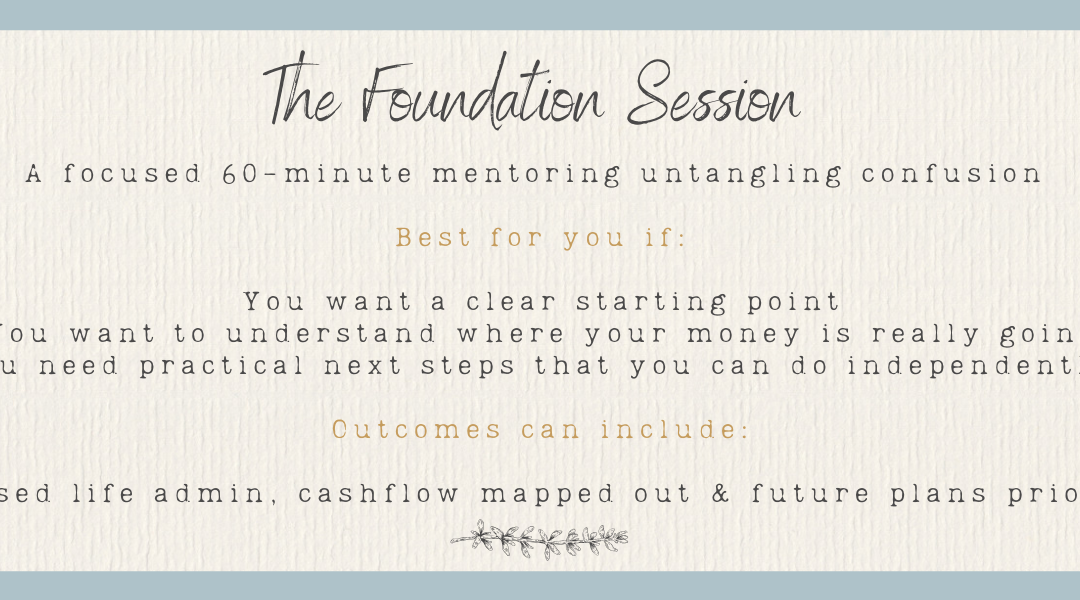
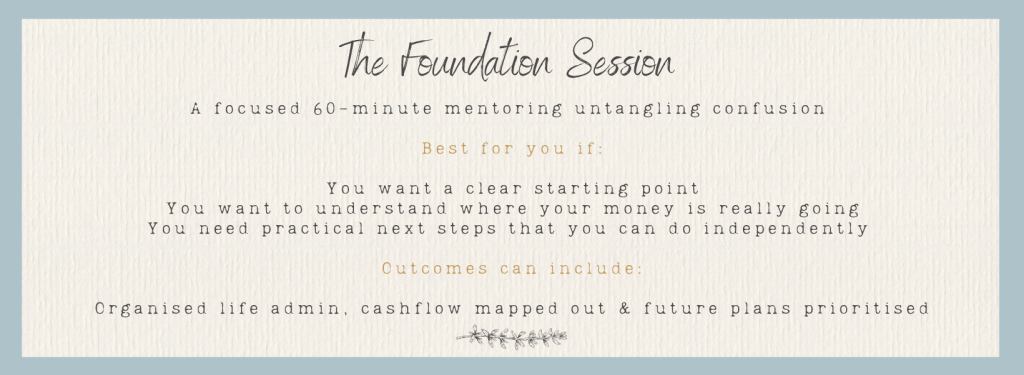
notecard inviting you to The Foundation Session

7. Solutions Matched to Problems

A visual, timeline-based financial map – can open up your world

Problem addressed: The gap between goals and action.

I suggested starting with a large-scale visual, a wall calendar or equivalent, with goals placed along a timeline in rough increments. Debt payoff at two to three years. Travel fund now. Longer-term savings in the medium term. Seeing these plotted out gives the brain something concrete to work toward, and converts abstract wishes into a visible plan.

The Three-Pot System

Problem addressed: Living month-to-month; no structure for savings or spending. I recommended organising household income into three clear streams: an essential needs account (bills, mortgage, non-negotiables), a savings account funded first before spending, and a spending account for everything else. This simple architecture changes the psychology, savings stops being the leftover and becomes the given.

Using the 13th-Month Bonus Strategically

Problem addressed: No travel fund; credit cards being used for holidays. I immediately identified the 13th-month salary payment as an ideal foundation for either an emergency fund or a dedicated travel fund, breaking the cycle of holidays going on credit. Not everyone is fortunate enough to get annual or seasonal bonuses anymore, so let’s make this work brilliantly.

Stop Using Credit Cards for Living

Problem addressed: Persistent credit card balances and accumulated interest. Gently but directly I suggested moving to debit cards for day-to-day spending while setting up a structured repayment plan for existing balances. The ‘coming downstairs to yesterday’s washing-up before the new day even got started’ metaphor I used made the logic visceral and memorable.

Changing this habit takes time. If you’re getting something special out of using your credit cards, like air miles that you use, and you’re paying them off in full each month so you have a strategic cashflow system built in, that’s a different story.

Emergency Fund as Immediate Priority

Problem addressed: No financial safety net. I repositioned the emergency fund not as a nice-to-have but as a prerequisite for financial wellbeing and investing. Even £1,000 to start, built up incrementally will settle your nervous system & ensure you feel less exposed.

Children’s Financial Education

Problem addressed: The intergenerational concern. I pointed Rosie towards age-appropriate children’s finance resources, including a book by one of my colleagues, to help her begin those conversations with her 10-year-old now at exactly the right age.

8. How She Felt at the End

There was a marked lightening in Rosie’s energy by the close of the session. She said the conversation had helped her see that she was ‘already on the right track’ and not ‘doing the wrong things’. The self-blame that had opened the session, ‘I’m really bad with money’ had transformed into something far more useful: clarity about what the next steps were and confidence that they were achievable. She finished with characteristic self-awareness and warmth: ‘I just needed to meet you’ which made my day!

9. Additional Insights

Rosie’s story is a powerful illustration of the difference between financial intelligence and financial systems. She had plenty of the former and almost none of the latter. Her case is also a reminder that self-awareness is not the same as self-help. Knowing what you should do is entirely different from having the architecture to do it.

Financial paralysis is what happens when capable, thoughtful people are overwhelmed not by ignorance but by too many options and too little structure.


If you would love to work through your story with me in confidence, with plenty of comforting support with emphasis being on the structural side that changes you, you can book in for a short conversation to see if we can fit together beautifully.

Then you can go ahead & book either a one hour Foundation Session or a 3 part Fairy Godmother Experience…


Finished your cuppa? What are your thoughts on this, please share in the comments.

Love from

Lucy x

ps. I’m on the edge of starting The Kitchen Table Money Club as a lovely low cost community on Substack where I can share with you eGuides, templates, monthly live tutorials …

I’d love to know, IF you were to join this (I’m not holding you to it don’t worry) what would you love to experience?

Live chats with guest experts? Monthly live tutorials? Discounts for my one to one services?

Let’s build this together.

pps.

  1. I have fortnightly (‘ish) emails that tell the very short story to help you start to resolve a particular financial element & point you towards several resources in a summarised way if that is your preference: Free Resources
  2. And I write a long form Substack publication fortnightly (‘ish) from where The Kitchen Table Money Club is starting in the coming several weeks.
  3. These blogs are usually a more How To version rather than a full on perspective shifter
  4. Linkedin Newsletter is similar to this blog: Subscribe on LinkedIn
  5. YouTube channel that I do try to do a new video fortnightly as well but not doing that great with those, if you are on the email list you’ll get a link to the new one or of course subscribe and you’ll get a notification.

    So there should be something to suit your preference & made as simple as possible to access.

    Thanks for reading and do pop your thoughts & questions in the comments.

    Lucy x
I don’t want financial freedom. I just want to stop worrying about money every month.

I don’t want financial freedom. I just want to stop worrying about money every month.

The Room Where Nobody Wanted More

“What would enough look like for you for the rest of 2026?”

Dozens of pairs of eyes upon reading this, would have looked up & right, pen tapping the corners of mouths whilst thinking about life this year thus far, and what would feel good for the next 7 months.

I’m a member of a community business group is full of brilliant minds, creative talent & genuinely honest support. A rarity. Over the course of the day, dozens answered this question in our online community.****

I shall paraphrase all of them into one:

“I want to be able to pay the bills, feel steady, know my family is healthy & happy, that my work matters, and we can enjoy our homes. Maybe a little holiday too…”

We all wrote a version of wanting peace. Not 6-figure months.

Tranquility.

Safety.

Why? Have we lost our ambitions for growing successful businesses? Is this even normal?


The Mental Health Reality

Edging towards 50 we start to want different things, of course we do! Each decade can be defined in your life as an era where you … and the latter part of each invariably moves us towards the next season.

What was interesting to me, is that a lot of my community colleagues are in their 30’s, and it seems like the universal desire is to feel calm & content. Not to shrink away, not to live in a bubble of invisibility, but to have a softness in life that creates a gentle daily energy. Finding joy in small things again, appreciating nature, art, morning coffee in the garden, home cooked food, clothes that fit well & made of natural fabrics and last year in and year out. A sensation of nostalgia sweetly reminding us of simpler times.

62% of UK consumers say the economy is worsening. 70% are experiencing financial stress weekly. The ONS savings ratio is at near-historic highs, not because people have more, but because they’re gripping tighter. The data that shows this isn’t a personal failure, it’s a collective, rational response to a genuinely difficult environment.*

Research from Confused.com surveying UK adults going into 2026 found that financial stability not wealth, not financial freedom is the number one goal, cited by 58% of UK adults. It ranked above travel, homeownership and every other aspiration on the list. RSM UK **

Hope and Shame: The Two Invisible Forces

According to the Cigna Healthcare International Health Study 2025, 70% of UK adults report experiencing stress primarily due to financial strain on a weekly basis.”

https://www.itij.com/latest/news/uk-cost-living-crisis-sparks-widespread-stress-and-health-concerns-study-finds

University of Southampton research found something striking about what sits between financial hardship and mental health outcomes. Hope mediated the relationship between subjective financial hardship and depression, stress and wellbeing.

Shame mediated the relationship between financial hardship and anxiety. Neither operated on the same symptoms. Hope and shame were doing different, distinct psychological work. nih This is profound: people struggling with money aren’t just worried, half of them are ashamed.

How do you feel?

I’ve spoken with clients who feel this way, who say they made in hindsight, risky financial decisions 10+ years ago, not really considering the impact if the economy changed. And now, they’re in trouble. Upsizing their homes, very normal as your family expands, but when you’ve got a £1000 a month mortgage that has now doubled and then some over the course of a few fixed rate cycles, it can make everything more than difficult.

New cars every 4 years as never ending expenses. Paying for holidays & Christmas on credit cards. Habits that feel like normal life can be emotionally tough to change.

Gone are the days of expecting your kids to share a room. No one imagined 25 years ago that each child would have TV’s and computers, £1000 iPhones & endless snacks on repeat. Both parents exhausted working full time. Our expectations of a nice lifestyle has overtaken the ability to fund it. And it stings. Especially if you’ve been used to it and now, things have to change.

One in three people said worries about being able to afford to pay bills made them anxious in the last two weeks. Mental Health Foundation

I sincerely hope this is not where you’re at? There is a wonderful array of support available. Step Change is one and Mind is another. You’re not alone, ever.


What You Actually Want (And Why That’s Enough)

Bills paid. Food on the table. A small family holiday. Sleep. Next few months covered. Things the kids need. Slower pace.

The psychology of sufficiency is not a lowered bar, it’s actually where genuine wellbeing lives. ***

Can we put a price on this?

Having one month’s income in savings reduces the odds of falling behind on bills by nearly 75%. Office for National Statistics

Enoughness as a radical, intelligent choice is worthy of a good old fashioned debate doncha think? Get your perspectives in the comments my friend.

And if you need something lighthearted to watch, how about The Good Life? A classic british comedy based on the courage to change from the suburban rat race to becoming self sufficient. The observation between Margot & Jerry, Tom & Barbara is wonderful, comfort TV even if you’d never consider in a million years having a smallholding in your garden or wear old jumpers with holes in.

Ironically, we probably know more than one eccentric very wealthy person who wears clothes like this, patches on patches.


The One Thing That Changes Everything

Control. Having agency over your own finances & choices. Not wealth, not financial freedom, the felt sense of knowing where you stand. Perceived control over your household finances is the single biggest predictor of financial wellbeing. Having a plan isn’t just a spreadsheet. It’s a nervous system intervention designed to work with your spending psychology day in and day out.

It’s having your expectations matching your reality. It’s still having dreams & aspirations, but it’s also learning to love what you have with a grateful heart and not feel that desperate pull for more. I learned & try to practice the approach that, there are thousands of gorgeous things to buy. Endless home styling & clothing inspiration on Pinterest. I can look, I can appreciate, I can get ideas but I don’t need to buy it.

When the shit hits the fan, yours and your family’s health is all that matters. When you’ve been on the brink of losing a loved one, you find an energetic tunnel vision like you’ve never experienced. You’d give up everything materially to make them better. Steve Jobs famously said “Death is life’s biggest change agent” (slightly paraphrased)

In fact, so powerful is this speech, I’m going to link it here for you to watch:

What now? Here’s How I Can Help

As your fairy godmother of household finances we can get all the practical elements of your day to day, quarter to quarter spending running like clockwork. We can figure out ways for you to be more economical, buying less but better and have a simple system that you will use to keep your control even in the face of adversity.

It doesn’t have to be a tight grip so you can’t breathe. In fact, I’d say it shouldn’t be. But your own flexible, budgeting system that ebbs & flows with your life is a skill you will never not use again. (Double negative, but it works)

Creating comfort, easy, steadiness will help you sleep at night. It won’t necessarily mean huge shifts in your lifestyle or going without, but perhaps there will be need for compromising.

I’ve a longer piece on this topic that you might like to read on Substack:

I’ll finish on this note. Building wealth, investing for your retirement will feel inspiring not impossible when you’re feeling steady. Trust me when I say that, as you skid into your 50’s you’ll want to feel like you’re in good shape for the next decade and beyond. You might even want to buy a house in France to semi retire to…

I know someone that can help you out with that – more on that another time.

So, do tell me in the comments, what is enough for you for the rest of the year?

Until next time

Lucy x

You can get my fortnightly emails with links to the latest blog, free eGuides & more here:

https://budgetingandplanning.co.uk/free-budgeting-resources/

**GfK (now part of NielsenIQ) has been running the UK Consumer Confidence Barometer every single month since 1974, which makes it one of the most reliable long-term measures of how British households are actually feeling. The score runs between -100 and +100. We haven’t been in positive territory for a decade.

Source: GfK Consumer Confidence Barometer powered by NIM.

The official monthly releases live at the NielsenIQ site — the April 2026 report is here:

https://nielseniq.com/global/en/news-center

The House of Commons Library also tracks it cleanly and is a highly credible source

https://commonslibrary.parliament.uk/research-briefings/sn02817/

**Source: Confused.com, January 2026 Link: https://www.confused.com/press/releases/2026/3-in-5-brits-put-financial-security-at-the-top-of-their-2026-goals

*** Source: Confused.com Life Insurance, January 2026 The precise stat: 58% of UK adults prioritise financial stability as their number one goal — above travelling abroad (54%) and owning a home (35%). Link: https://www.confused.com/press/releases/2026/3-in-5-brits-put-financial-security-at-the-top-of-their-2026-goals RSM UK

****