Do you trust your child (age dependent) to make decisions with pocket money?
How much do you give? And how did you come to this amount?
What are you expecting them to pay for out of that? And have you set these ground rules?
💡 ESTABLISHING HOW MUCH POCKET MONEY
Establishing pocket money values can be difficult.
I expect your kids will gladly tell you how much their friends are getting and how it’s “not fair” that they get less.
£9.74 is the UK’s 2026 pocket money index (yes that exists) but of course this fluctuates depending on age & affordability.
Mowing the lawn is the most popular job apparently at £3.50 a time! I suppose it depends on how big the lawn is & how much you despise doing it yourself! Do you expect your child to earn it, or do you prefer to just provide it?
We’ll explore the earning side below, and if you do decide to create a system for earning money, there are ways to approach it that suit the age and capacity of your child, plus you don’t want them demanding cash every time they make a contribution to the running of their home.
Rooster Money is a great resource. BUT, I’m going to say it right now because when you read this you’ll see the use of the word I hate: CHORES.
DO NOT CALL ESSENTIAL HOMEMAKING TASKS “C H O R E S”.
What a weight of burden & drudgery to give a young person!
Call them something energising & motivating;
“My Family Jobs” or “Team Smith Homemaking Projects”.
Here’s your link for more tips and suggestions > Rooster Money
💡 PERSONAL FINANCE SHOULD BE TAUGHT IN SCHOOLS
I have lost count for every time a person has said “Personal Finance should be taught in schools”.
I agree, and whilst financial literacy is different to maths, there needs to be a level of applied maths relating to real life. Some of that should be finance related. I do however believe, that learning about money is an experience.
Cash still creates an emotional and intellectual transaction in our minds. You know yourself how differently it feels to hand over a crisp £20 note, there’s a micro moment where you ought to let go but you don’t want to! And you can clearly see how much you have left, it goes fast.
A digital budget feels more abstract. (I feel passionate we don’t stop using cash despite what Elon says, I cannot imagine a sterile cashless society) and you have to keep track of it more carefully. With cash you can see right in front of you what you have left and that will always make you choose more intentionally in the moment.
💡EARNING POCKET MONEY – PRACTICAL IDEAS
Let’s say you’re going to encourage your kids to decide how they want to spend the treats budget for the weekly shop. Crisps, biscuits, fizzy drinks, percy pigs, whatever! They get to choose what they buy for that money. I can guarantee you’ll see them adding it up as they go around the supermarket, choosing the 3 for 2 offers, negotiating swaps with their siblings, and feeling ownership of the whole experience. This will include the understanding that when they scoff the lot in 3 days, they know that they have no more until the next shopping trip.
And that, is a lesson learned in real life, that no school could teach. It needs to be felt, lived and experienced. The consequences of their decisions viscerally felt.
When you’re young, being given money feels great. But, that doesn’t always create the same emotional resonance that is needed to form a positive bond with money.
A birthday gift is different of course & the odd pound here and there. But when your child has done something to exchange their skills and time for pocket money, then, pardon the pun, the penny will drop.
If you need to learn more about suitable cards for kids, you have more info here > MSE
💡 Exchanging time and skills for money is a great life lesson.
Putting out the bins, cleaning the fridge, hoovering the house, cleaning the car, carrying in the food shopping … the very act of contributing to the household in some meaningful way changes the game for everybody. I know some friends who have worked their fingers to the bone doing everything for their (seemingly ungrateful) kids and the resentment they felt was huge. The arguments attesting to this one sided split of fairness.
I also know a couple of single mums, who have had to raise their child / children where they contributed naturally to family jobs every day because it wasn’t possible for mum to do it all alone. That was their, very lovely, normal.
Only a couple of generations ago, including my own grandparents who were part of enormous families, 8+ siblings, it was normal that the eldest kids helped with the young ones and learned to cook & clean.
💡 Create a list, together, of suitable tasks.
Let’s say you pay £2 an hour, and call it 50p for each small job likely to take 15 mins. They can choose which jobs they’d like to do, maybe limited to weekends & holidays, or just one short job per day. They can have fun ticking things off that list. Great for friendly competition between them as well.
Caveat, when children are acting as carer’s to their unwell parents then that’s a whole different thing entirely.
Planning a family day out or set of activities for the school holidays.
Tell them there’s £50 for the day, or for a couple of activities, and it’s their fun responsibility to plan it for the family! They need to factor in cost to get there, how they will have something to eat and drink, and can they find any discounts? When they get involved in the conversation, become part of the planning and decision making, your mental fatigue is removed. And you say goodbye to the constant negotiations and explaining that you “can’t afford it”.
A great reframe here, for your own benefit as much as there’s is “It’s not in the budget” or “We’ve got other plans for that money”
Gamify it so that it’s interesting, and you’re teaching them critical thinking skills. They may realise very sweetly, that they’d rather save you the money and do something for free instead. And they can do the research for that too.
Have you tried Muddy Stilettos for what’s going on in your area?
And the National Trust have a Summer of Play program and events throughout the year.
What else would you suggest?
Thanks for reading
Lucy x
ps. If you like these blogs but prefer to go into things a bit more deeply; more resources, more guidance, more support, more stories, just, you know, MORE, head over to The Kitchen Table Money Club where you can unlock ALL of my digital toolkits.
He’d booked the session to talk about money. Specifically, he wanted to know how to make the most of an ISA, how compound interest worked, and whether there was a way to claw back some breathing room before the next unexpected bill landed.
That’s not actually what the session ended up being about.
What he said he needed
On paper, his situation looked manageable. No credit card debt. No loans. A joint savings pot with a healthy five-figure balance. A stable job he’d held for years and genuinely liked. By most measures, he was doing better than a lot of people in their early thirties.
But he arrived at the call sounding like someone bracing for bad news that hadn’t happened yet. He used phrases like “scraping by” and “struggling” about a financial picture that, from the outside, had real strengths.
He’d recently had to replace his laptop and described it less like an inconvenience and more like a small crisis. He was a first-time homeowner a few months into a renovation that had gone sideways. Multiple tradespeople, multiple do-overs, a project that was meant to take ten days and was closing in on six weeks.
He wanted budgeting tips. He wanted to understand savings products better. He said, more than once, that he was “a complete novice” with this stuff.
What was actually going on
About ten minutes in, a different picture started to form.
He wasn’t wrong that budgeting confused him, it did, genuinely.
Numbers on a page, products with names like ISAs, the difference between an individual bank account and a joint one: none of it sat comfortably in his head, and he was visibly embarrassed about that, more than once apologising for not already knowing things he assumed everyone else just understood. But underneath that confusion was something heavier, a constant sense of being out of control.
A house project he didn’t fully understand the terms of.
A household where he’d quietly cast himself as “the lower earner,” the less capable one, the one who just tries to keep his head down and get through the month.
Every time the conversation moved toward a number, he’d defer: “she’s more clued up with that,” “she’s handling that side of things,” “I’ll leave that to her.” Not with resentment, more like it had become a settled fact about who he was in this partnership. We all have roles, I’m the admin, calendar organiser, IT department in our house. But when it comes to money, it’s really got to be a team effort and ours certainly is.
The laptop problem wasn’t really about the laptop. It was a stand-in for a feeling: that life kept throwing things at him faster than he could prepare for, and that he didn’t have the tools, or the confidence to push back.
The solution that wasn’t on the agenda
He didn’t need a masterclass in ISAs, thank goodness for me as product specific support isn’t what people need me for. He needed two much smaller, much more achievable things.
The first was permission to feel less ashamed. Naming, out loud, that having no debt and five figures in savings while going through a brutal renovation isn’t financial failure, it’s just a hard 12 months. This recognition did more for him in thirty seconds than any spreadsheet could have. He visibly relaxed when I simply said: you’re actually in a good position, even though it doesn’t feel like it right now.
The second was a method, not a lesson. He mentioned, almost as an aside, that he’s a visual learner, that he likes to write things down and see them. So instead of explaining percentages and interest rates, we built a plan around post-it notes and a calendar. Months written out. Expected costs sketched in. A rough shape to the chaos, something he could literally see on his fridge instead of carrying around in his head.
He left calmer. Not because his renovation problems were solved, they weren’t, not even close, but because he now had a way to make the unknown feel slightly less unknown. Just to have that permission that he’s on a learning trip, like most of us are, to gain more life knowledge by not being afraid to ask questions until the answers made sense, was a real awakening.
The bit that’s still unfinished
There’s a thread we didn’t get to pull on, not in one short session. The way he talked about his role in the relationship, the lower earner, the one watching his partner do all the heavy lifting while quietly thinking she shouldn’t have had to. It sounded less like a financial issue and more like a partnership figuring out, under pressure, how two people share both money and decision-making. And that, as many of us know, is a BIG thing to get right.
That’s not something a single conversation about budgeting was ever going to fix. But it’s worth naming, because it’s a reminder that when someone asks for help with money, they’re not always asking for the thing they think they’re asking for. Sometimes the real ask is quieter: tell me I’m not failing, and give me something I can actually hold onto.
A lot of financial advice assumes the problem is a lack of information, and that the client is simply not doing the thing that makes sense logically. That if they just understood ISAs, compound interest, or budgeting categories well enough, the anxiety would lift on its own. Sometimes that’s true. More often, especially when someone is mid-crisis, the numbers are the symptom, not the disease. The real work is steadying someone enough that they can think clearly, then giving them a structure simple enough to actually use when life is still chaotic.
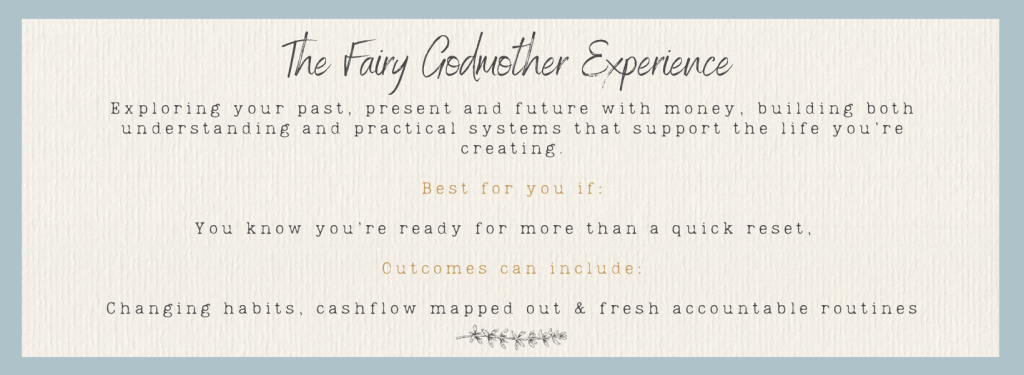
That’s the whole premise of this experience: not a magic wand, not “here’s your budget, off you go” and stick to it, but a relationship that holds both the practical and the emotional at once, over more than one sitting, because almost nobody untangles their relationship with money in thirty minutes.
THE EXPERIENCE is designed specifically for someone who needs a bit more unravelling to get to the nugget of the problem. For the person who is really unconfident in their abilities to grasp this, or the person who knows that everything feels like a mess and they don’t know where to start.
Here’s how the next two sessions unfurled for him:
Session two: Naming the real picture, together.
With the panic of session one settled, and trust built, this is where we’d actually open the spreadsheet or rather the post it’s & notebooks. We mapped out the renovation timeline he’d started sketching on post-its, layer in the eventual rental income, and turn “I think we could understand it and talk through it” into an actual shared document both of them use. This is also where I gently test what he really understands about products like ISAs, rather than assuming not to catch him out, but so the explanations land at the right altitude instead of past him. Something he can approach in a few months when the biggest stressor has subsided. And, crucially, where to go for this kind of support.
But the point of this session is to reveal the numbers, as they are, and start to point them towards the end goal. And end goals will change, but this process can be repeated. It’s sustainable.
Are the bank accounts lined up to accommodate these goals? Are they simple, clear and user friendly? Do both partners know what they are contributing to, how much and how exciting this is?
Session three: Rebuilding his seat at the table.
This is the session that isn’t really about money at all, even though it’ll look like it is. We talked about what it’s meant for him to have created this role. Not couples therapy, that’s not my lane, but enough space to ask: what would it look like for you to feel like an equal architect of this plan, not a passenger in it? Often, that single shift in how someone sees their own role does more for their financial confidence than any spreadsheet ever could.
By the end of three sessions, the goal isn’t that he’s become a finance expert with everything in place. It’s that he walks into his next unexpected repair, leak, or invoice with a place to put it. A plan he helped build, a voice he trusts using, and the quiet knowledge that he’s not scraping by. He’s just in the middle of something hard, with someone in his corner until it isn’t.
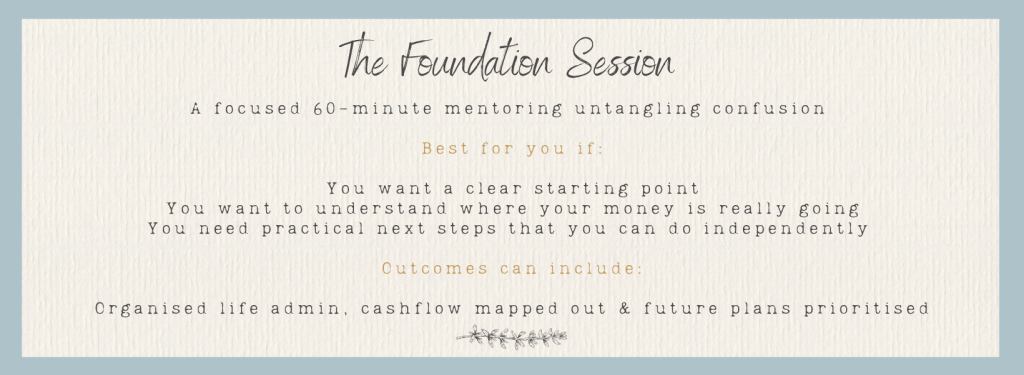
Three sessions of practical financial mentoring delivered with lashings of emotional intelligence. We take things at your pace overcoming any anxiety about maths or tech.
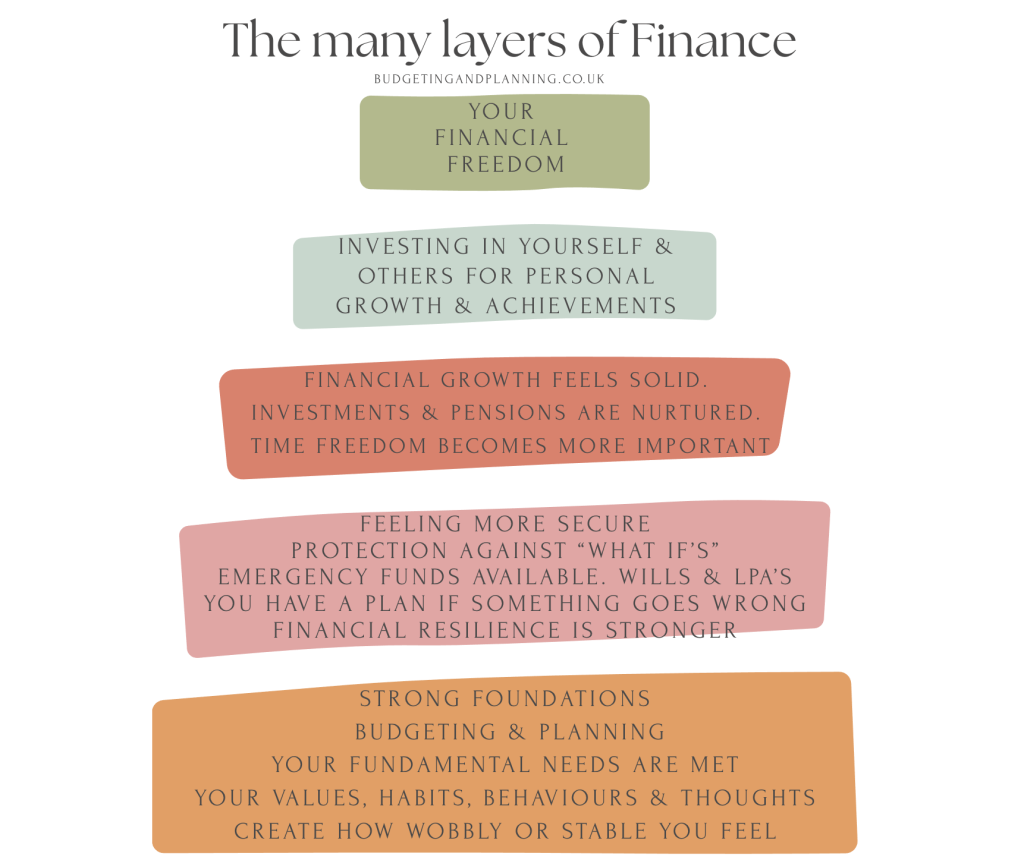
Your season of life is now putting you in the spotlight to manage your finances, let’s lay the best solid foundations for you.
We’re renovating, slowly, our barn and home that we bought 6 years ago. My husband is an architect, I know, I’m lucky! BUT we have a smaller than expected budget, long story for another time, so it’s been essential that we seriously keep an eye on the pennies & euros.
Here’s the thing;
He has been using a spreadsheet for decades for his architectural business projects. It’s a bit serious for most of our home based tastes, but I wonder, if I were to create a gorgeous user friendly version, if you’d love this to manage all kinds of projects with?
Do let me know in the comments OR pop your email address into here so that you get my fortnightly emails! This way, you can be involved in the creative process as I often ask my lovely penpals questions about what they’d find most useful, so I create what is truly wanted.
Until next time
Lucy x
ps. my characters are always a mash up of real clients not one person’s story unless I have their permission.
Thrilled to be asked to guest speak on Investing Insiders Podcast, I’ll confess that I was a bit nervous. Investing is not my forte; I’m not without knowledge but it’s nowhere near podcast levels. But that’s not why they wanted me.
Brean Horne is a wonderful finance writer and the host of this epic podcast. We had planned around 10 questions and then we got carried away, on a tangent, like the best conversations do!
Budgeting, planning, having a direction or vision (goals), learning how to make the numbers work in real life, and improving one’s relationship with money is the starting point to a life that feels financially rich – even if the numbers suggest a slightly different reality. After all, what really is “enough”?
I don’t think there’s enough oomph in this area!
The basics, fundamental money training is often glossed over, which is why I love it so much and why I work in this space. And how, via a bit of fun whilst networking, I became The Fairy Godmother Of Household Finances. It was either that or Nanny McPhee 🤓 need and want etc…
This will whisk you away to where I’ve created a thoughtful self assessment, to help you refine where you think you stand, and what your next steps could be. You’ll get a lovely summary, plus a deeper version to your email inbox should you wish it.
This podcast was a joy to be part of so I want to wholeheartedly thank Brean Horne of Investing Insiders UK for inviting me on. And because it’s a 45 min edition I wanted to summarise my 5 favourite points below.
If this whets your whistle then you can head over to my Substack to read the longer version & feel free to download the podcast & give it a lovely ⭐️⭐️⭐️⭐️⭐️ rating.
My 5 Q&A’s to share out of the 12
Q: What reasons make people feel they can’t talk about money as they get older?
The teenage years can change everything you’ve known thus far. When my parents divorced in the late 80’s this was quite unusual back then. I had to use lunch tokens at school and the mean girls loved that! That stigma can attach itself to you, because the meaning of money shifts with every season of your life. And teens can see you used to be dropped off at school in a posh car, but now you’ve got lunch tokens. That’s juicy gossip and they’re not letting that go!
Then university debt can layer on top until your first proper job arrives and suddenly a bank is offering you what feels like free money! Overdrafts and credit cards don’t come with training on how to use them. And unless you really know what you’re doing, £1,000 spent on bits & pieces becomes £1,200, becomes £1,500, and you can find yourself in an ever-decreasing circle if you’re not careful.
Money can become the enemy. When your young adult brain realises that you work really hard but you still can’t have the instagram lifestyle you dream of, a bit of resentment can kick in. Without the emotional intelligence learned by experience, this is an age where your habits set the tone for the next decade.
Getting older can exacerbate the thought pattern of being disappointed that you haven’t achieved things. Or you haven’t got The House of your dreams. Or you did have the things for a while, but circumstances changed everything you knew, so you’re now living smaller. You can feel like you’re failing when your expectations don’t match your reality.
Comparisonitis is often still there. Feeling grief for a life that has passed you by that hasn’t worked out as you thought. This stuff makes it hard to talk about money because it intertwines with feelings of self worth. When your pride takes a fall, life gets questioned.
Q: How do people take that real step to make a change rather than just putting a plaster over it?
It’s often down to a big identity shift that can happen around a milestone birthday, approaching 30, 40 or 50 when you want to become a version of yourself that has things a bit more together. When you’ve been kicking problems down the road, at some point they meet you around every corner and it starts to feel heavier. That’s when shame and guilt can kick in, the “I should have dealt with this sooner” feeling.
But we’ve all done it. I wanted to go on holiday with friends in my 20s, didn’t have the savings, put it on a credit card. It’s part of learning, usually the hard way!
I think for many of us, if the learning doesn’t translate into new actions and new ways of doing things, we keep doing the same things, aka the definition of madness. Or, we find ourselves trapped in a lifestyle we really wanted but can’t afford anymore.
It takes a lot of courage to make a change.
Having to say no to things. Downsizing your home & changing new cars for second hand when it feels like all around you, the trajectory is only upwards feels like you’re driving the wrong way down a one way street.
If your identity around money no longer fits who you are, or who you want to become, you can change this. If you want to be the kind of person who has a comfortable home and no debts, who feels in control and steady with money every day then that’s an identity shift. When you see yourself as this person, you’ll create better habits, routines, and make different decisions. Then you’ll become that version of you.
It’s like looking at a slender, strong, and healthy body shape and wanting so badly to look that way. You have to become the person who does the things, that make them look like that. That’s an identity shift.
Q: How do you separate where you are financially from the shame and judgment around it?
Language matters enormously, and there’s neuroscience behind this.
When you say “I’m in debt” this feels very different from, “I have some debt”
This reframe keeps your identity intact. The real challenge is bridging the gap between knowing and doing and that gap can feel impossible. I always compare it to getting on the scales when you’ve been avoiding it. You look down and can see even through a half glance you’re heavier than you thought. You exclaim “Right, that’s it! I’ll clear out all the naughty food” so you eat it all to get rid of it before Monday. By Thursday you’re giving in to the cravings for more.
Because you haven’t bridged that emotional gap. The “just do it, ” the just eat less & move more is certainly logical, but it’s largely useless here because your limbic system can veto your prefrontal cortex’s good intentions.
When there’s a real emotional charge, telling someone to “do a budget” will layer on pressure. This often results in inaction because it feels too huge a step to take. Or with an all or nothing approach, someone going all out for a few unsustainable weeks will revert to normal behaviour before too long.
Q: For someone new to budgeting, what is the first step to getting a system that works?
The word “budget” makes people recoil doesn’t it?! They think financial diet & deprivation. It’s not that at all!
Think of it like filling in a diary at the start of the year. Whose birthday is when? When’s the holiday? What’s coming up? Budgeting & Planning is just the same principle applied to money. Here’s our life, now let’s make the money fit the picture.
The first step isn’t letting the numbers tell you what you can do.
It’s deciding what you want to do and making the numbers work backwards from there. When you know you’re saving for a really wonderful family holiday, you stop wandering into a shop and coming out £50 lighter on things you’ve already forgotten you bought.
Every single thing you buy needs to matter, otherwise you’re just taking money away from things you said you wanted. You’re depriving yourself.
Likewise if you’re dreaming of things, of a life that isn’t attainable on the income you have, then something’s gotta give. Choosing lifestyle (or any) goals has to be achievable or you’re setting yourself up to fail.
Q: What are the alarm bells around using credit as a default strategy?
Credit isn’t the enemy, chaos is.
The not knowing, the not using it intentionally or strategically. Used well, credit is a brilliant ally. But “let’s bung it on the card” is never a spending strategy.
I worked with someone who permanently carried about £3,000 on her credit card. It bubbled up and down but always settled back there. She’d accepted it as her normal. Then we got the calculator out and looked at what her “bargain” sale purchases had actually cost her with interest added over time….
That said, spontaneity is one of many sparks of joy in life! We can’t plan everything nor should we.
If a friend rings about getting tickets to your favourite band, and it’s not in the budget, use your credit card if you’ve no savings, go, enjoy it!
Just fit it into your budget retrospectively and pay it back. You’ve still got to live!
Which is why having a savings pot for such things going forward is a gorgeous idea.
So if money isn’t the goal, what is? The goal is life: to have a good one. We’re only here for a short while. Make the most of it! Money is just the tool you use to shape that life. Or as my granddad used to say “It’s all an experience”.
Lucy prior
Are you shaping your own good life?
Until next time
Lucy x
ps. As many of us thrive in a community based on a particular theme, I’m looking to figure out the appetite for creating a Substack Kitchen Table Money Club. A low cost community with just the right amount of support, resources and training to make it a lovely place to belong.
Not too much that you feel like you’re missing things & feeling worse still! But just enough that you can pop in, download a guide, a toolkit, take part in some chats & get your questions answered. If this sounds like a good idea, can you pop an emoji or a comment below, so I can guage interest?
The psychology behind the gap between knowing and doing & how to finally close it
Knowledge gap → learned helplessness
Without the knowledge of how to apply what we’ve read or heard, we disengage. Or get it wrong. And when we get it wrong or enter that whole new world of frustrated learner, it’s unlikely unless we’re super determined, that we’ll keep going with it.
For me it’s like following a recipe you’ve never seen before. If there’s no image & just basic instructions, it doesn’t really click until I watch someone actually make it or at least see some pictures of what it’s supposed to look like.
How, how do I fold in the cheese?
You just, you fold it in David!
It’s a recipe, the instructions are there, but Moira has absolutely no framework for translating the instruction into action. If you’ve never seen the series…. what are you waiting for?
The broader series arc is genuinely one of the most elegant depictions of identity reconstruction around money, ever put on television without it really being about money explicitly. In the same way that Ted Lasso isn’t really about football.
The Roses don’t just lose their wealth, they lose their entire self-concept that was built on it. What the series tracks is the slow, often painful, occasionally joyful process of finding out who you are when the financial identity is stripped away. Which maps directly onto everything I often discuss; present bias, identity, emotional reappraisal, & getting back to basics.
I love that it ended optimistically. They come out the other side with stronger identities, better relationships, and arguably more self-awareness than they started with. That’s a really hopeful message about money psychology, that financial disruption doesn’t have to be the end of the story.
Of your story.
Even if it feels that way at the time.
Anyway… back to knowing & doing.
The Science Bit
This is a well-trodden area in psychology and there are a few clean frameworks that explain it.
The core problem is that knowing lives in one part of the brain and doing lives in another, and they don’t automatically talk to each other.
Knowing is largely a prefrontal cortex function; rational, analytical, future-oriented.
Doing is driven by the limbic system; emotional, immediate, threat-sensitive.
When there’s any emotional charge attached to a task (fear, shame, overwhelm), the limbic system can effectively veto the prefrontal cortex’s good intentions. This is why “just do it” advice is largely useless.
Nike has never worried about that!
“Just do it” works brilliantly when the barrier is mild hesitation in someone who already has the skills, the confidence, and a positive emotional association with the activity. AKA was already going to do it. A runner who doesn’t feel like going out this morning for example, shows the friction is low and the reward is immediate and known, so that simple yet powerful tagline is a motivating nudge.
This falls apart when the task carries overwhelm, if the person lacks confidence or skill, or if the reward is distant and abstract. “Just do it” (or JFDI as we used to say at work) just adds a layer of self-blame. Now they know what to do, they’ve been told to just do it, and they still haven’t. So clearly something must be wrong with them.
Which is actually a nice illustration of the gap itself. Nike’s slogan is one of the most effective pieces of marketing ever created, everyone knows it, it’s deeply embedded in culture, and yet the global inertia around exercise hasn’t noticeably shifted. Knowing the instruction and feeling the identity pull of it doesn’t reliably produce the behaviour.
What I’m essentially saying is: “just do a budget” is the financial equivalent of “just do it” & it’s assuming the barrier is purely laziness or ignorance, when actually the barrier is psychological, emotional, and neurological. And that’s exactly why the way I present budgeting matters as much as the budgeting itself.
Do you think managing your money comes down to discipline or do you believe there are other ways?Please use that comment section!
How do we connect our prefrontal cortex to our limbic system? Can they work cohesively? Is it a habit thing? Or more of a connection to self identity?
my curiosity whilst writing this blog …
The honest answer is that you don’t override the limbic system with the prefrontal cortex, that battle is one the limbic system wins more often than not. As in, “we buy with our emotions then justify with logic”.
The goal is to get them working in the same direction, which happens through a few distinct routes.
Regulation first, cognition second
The prefrontal cortex goes offline under stress and threat. So the first job is always nervous system regulation. No one makes a good financial decision under stress, you can’t think your way into calm, but you can feel in your body to get you there. Breathing, movement, grounding. Once the threat response is dialled down, the prefrontal cortex comes back online and rational engagement becomes possible. This is why sitting down to do your budget when you’re already anxious and overwhelmed almost never works. Or ends abruptly in tears
Habit: Automating past the gap
Habits are powerful precisely because they bypass the knowing-doing gap entirely. A habit doesn’t require the prefrontal cortex to initiate it runs on a cue-routine-reward loop seated in the basal ganglia. So once a behaviour is sufficiently habituated, the emotional resistance becomes largely irrelevant. You just do it (thanks Nike you can enter the conversation now) before you’ve had a chance to feel bad about it. The challenge is getting through the formation period which is where environmental design, implementation intentions, and community come in. And me. That’s where I come in to be your fairy godmother.
Identity: The deepest lever
This is probably the most powerful and the most underused. The psychologist James Clear articulates it well, behaviour change that starts with identity is stickier than behaviour change that starts with outcomes.
“I want to save money” is an outcome.
“I am someone who proactively chooses where their money goes” is an identity. The limbic system is deeply invested in acting consistently with who we believe we are so if the new behaviour is congruent with the self-concept, it stops feeling like effort and starts feeling like expression.
This is also where shame does its most damage. If someone’s identity includes “I’m bad with money” then doing the household budget feels threatening to the self-concept in a different way. It might confirm the story. Avoidance protects the identity, even a negative one, because at least it’s familiar.
Emotional reappraisal
This is a prefrontal cortex skill that can be trained. The ability to consciously reframe the emotional meaning of a situation. Not suppressing the feeling, but shifting the interpretation. I reframed a difficult financial period as a “declutter” rather than a crisis. Ali, my mate, who’s an exceptional Solutions Focused Hypnotherapist does this too when she suggests “intentional spending” over “cutting back” on her podcast that she invited me to speak on. Both are nudging the limbic system toward a less threatening read of the same situation, which reduces the emotional veto.
Reward proximity
The limbic system responds to immediate reward. So attaching something genuinely pleasurable to the task. Ali’s Sunday morning coffee ritual is a perfect example, it starts to build a positive emotional association over time. Eventually the cue (Sunday morning, coffee) triggers a mild positive anticipation rather than dread. The behaviour and the good feeling become linked in the limbic system’s memory, which is the neurological basis of habit formation.
This is why I’ve renamed my Substack & Linkedin publications to The Kitchen Table Money Club. I’m there with you slurping coffee, mentoring you through each step of sorting it out & help to make it feel good!
If you’d like to listen to Ali & I here is the podcast link so you can line it up for your next commute:
The connective tissue between them
If there’s one thing that sits right at the intersection of all of these it’s probably self-compassion. A regulated nervous system, a flexible identity, the ability to reappraise, all of these are much more accessible when someone isn’t in a shame spiral. Brené Brown’s work and the clinical research behind self-compassion, consistently shows that people make better decisions, take more considered risks, and persist longer when they’re operating from self-acceptance rather than self-criticism.
The inner critic is a limbic system creature. Compassion is how the prefrontal cortex talks back to it.
How does yours sound?
Like the two headed monster from Sesame Street?
So, how do you know what to do?
When the gap isn’t a knowledge problem, it’s a design problem. The question isn’t “how do I know more?” or “How can I do more?” but “How do I make the right action the easiest action?”
Which is precisely what we do together (and what good therapy does, see Ali for that)
We redesign your environment and your relationship to the task until the gap closes naturally. We reduce the friction & increase the pleasure. (That actually sounds filthy, now I’m reading this back in edit, sod it it’s staying!)
If you DO have sufficient knowledge, but you can’t actually make yourself do the thing, it’s likely boiling down to confidence with a dollop of needing a gentle nudge forwards and the first few steps laid out very clearly. Like a recipe!
Interested in how to regulate your nervous system so that you can get your prefrontal cortex back online?
It’s in the next blog…
Until next time
Lucy x
ps. If you want the full monty experience sign up to my free Substack Publication here:
Get the kettle on & let’s explore Rosie’s transformation from having no back up & no savings…
It’s fair to say that these case studies stem from real sessions with me, however, I have combined stories & tweaked details because I do NOT, talk about clients unless I have their express permission to do so.
Whilst there are many money stories, they do form patterns and it is these patterns I use to share with you. Self recognition in these stories is intrinsically linked to getting underneath your own heart & soul beliefs. This can gift you the words to use that otherwise feel impossible to reach. When you can say it, you can move through it.
It is only then, as you nod along, feeling it in your bones that you know you’re not alone. You can and will have a gorgeous relationship with money when you get to the root of how you’ve been feeling up to now, and how you want to feel & live from now.
Let me know please, in the comments, if this resonated so that we can gather around our Kitchen Table Money Club & I’ve got a ps at the end that is ripe for your input.
CASE STUDY : ROSIE
1. How She Felt Coming Into the Session
Rosie arrived with a lot on her mind and a lot of courage to name it. She described herself plainly and honestly: ‘I’m not very good with money.’ And yet, as the session quickly revealed, this was far from the full picture. Beneath the self-criticism was a thoughtful, bookish, goal-oriented woman who had already done a great deal of thinking about where she wanted to go financially, she just hadn’t been able to find the bridge between knowing and doing.
There was a palpable emotional undertone to how she spoke about money: a quiet anxiety that arrived with the word ‘scary’, and a sense of vulnerability, almost nakedness when she described her situation. She spoke of feeling ‘stuck’, of not having savings, not having assets, not having family who could step in if things went wrong. This was not just financial stress. It was existential: a fear of being exposed and unsupported in the world.
She was also self-aware enough to name the pattern: she was strong in theory, weaker in application. ‘Aint that the truth for many of us?
She knew what she should do, but the gap between knowing and doing was vast, partly because of procrastination, partly because of overwhelm, and partly because she had never found a system that felt genuinely hers.
2. What Her Key Problems Were
Credit card debt across multiple cards accumulated gradually through a habit of using credit for convenience rather than strategic borrowing, with interest quietly building over time.
No emergency fund, a glaring gap that left her and her husband exposed to any unexpected cost.
Living month-to-month despite a good household income, with the nagging sense that something was ‘missing’ in how she managed money but unable to identify what.
Sporadic and inconsistent budget tracking. She had tried, had good tools (including an app & an elaborate spreadsheet she’d randomly downloaded) but she consistently fell off the wagon. She found all the data-gathering was demotivating, time consuming especially without visible progress & couldn’t really translate the data into daily actions. It wasn’t making sense.
No travel fund so that holidays kept going on credit cards, which is one reason the balance never truly reduced.
A gap between her many financial goals (which she had clearly defined) and a practical system to achieve them.
3. What She Had Already Tried
Rosie was already ahead of many clients in one important way: she knew her goals. She had a five-part financial vision.
Debt payoff in two to three years
A travel fund for this year
Stronger savings in the medium term
Eventual property investment
A more controlled day-to-day budget
She had mentally assigned rough timelines to each. She and her husband had opened ISA accounts (a Lifetime ISA for her, a cash ISA for him) and were saving small but consistent amounts. She had used budgeting tracker apps, checked her banking app more regularly, and had even tried the elaborate spreadsheet. She had attended the session with me deliberately and proactively, treating financial literacy as a project worth investing in.
We do all get to an age, a season, when we just KNOW that something’s gotta give.
4. What Would Happen If She Didn’t Change
The consequences of inaction were clear, even without spelling them out dramatically. A good income and clear goals mean nothing without a system to translate them into action.
The credit cards would keep accumulating interest quietly in the background so every purchase cost considerably more than she considered. When your interest on purchases is 29% APR (or any amount over zero) any bargains you bought are certainly not that any longer.
The emergency fund would stay absent, meaning the credit card balance will tiptoe ever closer to the limit with necessary unexpected spending. And perhaps most painfully: Rosie would continue watching years of solid earning produce no lasting financial security which was something she was already grieving.
There was also the intergenerational dimension. She had a 10-year-old daughter, and part of her motivation was explicitly about breaking the cycle: not passing on the same financial confusion she had inherited from her own parents.
“I’ve been earning my own money for 20 years now. My mum didn’t tell me much about how to manage money so I’ve bumbled along not making the best choices. Now I feel scared”
5. How She Recognised She Needed to Change
Rosie’s recognition came through a combination of fear and clarity. She’d reached a point in early January where she looked at her goals, the projects she wanted to pursue, the property she wanted to buy, the security she wanted to build, and felt frightened by how far away they seemed. That fear was the catalyst. She made a direct connection between her financial situation and her sense of being ‘stuck’, and she reached out. The very act of booking the session was itself an act of readiness.
6. How I Guided Her
I immediately reframed Rosie’s self-criticism ‘I’m not very good with money’ into something more accurate and more useful. I reflected back that she actually had a very healthy relationship with money, clear goals and genuine respect for it. What was missing was both the practical system to bring it all to life & evolving her habits that hadn’t changed much since she was in her twenties. This reframe was not flattery it was a coaching move that shifted Rosie from shame to agency.
Oftentimes, we think we’re terrible at something because we are our own biggest critics. When I listen to you, I hear a different story, a different set of skills you didn’t credit yourself with.
I listened carefully enough to hear what Rosie needed: not a rigid formula, but a personalised framework. She asked about learning styles, we talked about making things visual which she loved. We discussed their income structure (salary plus bonus 13th-month payments), about the relationship dynamics around money (one joint household pot, which simplified things), and about what tools had and hadn’t worked before. Each answer shaped the next move.
7. Solutions Matched to Problems
A visual, timeline-based financial map – can open up your world
Problem addressed: The gap between goals and action.
I suggested starting with a large-scale visual, a wall calendar or equivalent, with goals placed along a timeline in rough increments. Debt payoff at two to three years. Travel fund now. Longer-term savings in the medium term. Seeing these plotted out gives the brain something concrete to work toward, and converts abstract wishes into a visible plan.
The Three-Pot System
Problem addressed: Living month-to-month; no structure for savings or spending. I recommended organising household income into three clear streams: an essential needs account (bills, mortgage, non-negotiables), a savings account funded first before spending, and a spending account for everything else. This simple architecture changes the psychology, savings stops being the leftover and becomes the given.
Using the 13th-Month Bonus Strategically
Problem addressed: No travel fund; credit cards being used for holidays. I immediately identified the 13th-month salary payment as an ideal foundation for either an emergency fund or a dedicated travel fund, breaking the cycle of holidays going on credit. Not everyone is fortunate enough to get annual or seasonal bonuses anymore, so let’s make this work brilliantly.
Stop Using Credit Cards for Living
Problem addressed: Persistent credit card balances and accumulated interest. Gently but directly I suggested moving to debit cards for day-to-day spending while setting up a structured repayment plan for existing balances. The ‘coming downstairs to yesterday’s washing-up before the new day even got started’ metaphor I used made the logic visceral and memorable.
Changing this habit takes time. If you’re getting something special out of using your credit cards, like air miles that you use, and you’re paying them off in full each month so you have a strategic cashflow system built in, that’s a different story.
Emergency Fund as Immediate Priority
Problem addressed: No financial safety net. I repositioned the emergency fund not as a nice-to-have but as a prerequisite for financial wellbeing and investing. Even £1,000 to start, built up incrementally will settle your nervous system & ensure you feel less exposed.
Children’s Financial Education
Problem addressed: The intergenerational concern. I pointed Rosie towards age-appropriate children’s finance resources, including a book by one of my colleagues, to help her begin those conversations with her 10-year-old now at exactly the right age.
8. How She Felt at the End
There was a marked lightening in Rosie’s energy by the close of the session. She said the conversation had helped her see that she was ‘already on the right track’ and not ‘doing the wrong things’. The self-blame that had opened the session, ‘I’m really bad with money’ had transformed into something far more useful: clarity about what the next steps were and confidence that they were achievable. She finished with characteristic self-awareness and warmth: ‘I just needed to meet you’ which made my day!
9. Additional Insights
Rosie’s story is a powerful illustration of the difference between financial intelligence and financial systems. She had plenty of the former and almost none of the latter. Her case is also a reminder that self-awareness is not the same as self-help. Knowing what you should do is entirely different from having the architecture to do it.
Financial paralysis is what happens when capable, thoughtful people are overwhelmed not by ignorance but by too many options and too little structure.
If you would love to work through your story with me in confidence, with plenty of comforting support with emphasis being on the structural side that changes you, you can book in for a short conversation to see if we can fit together beautifully.
Finished your cuppa? What are your thoughts on this, please share in the comments.
Love from
Lucy x
ps. I’m on the edge of starting The Kitchen Table Money Club as a lovely low cost community on Substack where I can share with you eGuides, templates, monthly live tutorials …
I’d love to know, IF you were to join this (I’m not holding you to it don’t worry) what would you love to experience?
Live chats with guest experts? Monthly live tutorials? Discounts for my one to one services?
Let’s build this together.
pps.
I have fortnightly (‘ish) emails that tell the very short story to help you start to resolve a particular financial element & point you towards several resources in a summarised way if that is your preference: Free Resources
And I write a long form Substack publication fortnightly (‘ish) from where The Kitchen Table Money Club is starting in the coming several weeks.
These blogs are usually a more How To version rather than a full on perspective shifter
YouTube channel that I do try to do a new video fortnightly as well but not doing that great with those, if you are on the email list you’ll get a link to the new one or of course subscribe and you’ll get a notification.
So there should be something to suit your preference & made as simple as possible to access.
Thanks for reading and do pop your thoughts & questions in the comments.
Used to determine whether a user is included in an A / B or Multivariate test.
18 months
_ga
ID used to identify users
2 years
_gali
Used by Google Analytics to determine which links on a page are being clicked
30 seconds
_ga_
ID used to identify users
2 years
_gid
ID used to identify users for 24 hours after last activity
24 hours
_gat
Used to monitor number of Google Analytics server requests when using Google Tag Manager
1 minute
_gac_
Contains information related to marketing campaigns of the user. These are shared with Google AdWords / Google Ads when the Google Ads and Google Analytics accounts are linked together.
90 days
__utma
ID used to identify users and sessions
2 years after last activity
__utmt
Used to monitor number of Google Analytics server requests
10 minutes
__utmb
Used to distinguish new sessions and visits. This cookie is set when the GA.js javascript library is loaded and there is no existing __utmb cookie. The cookie is updated every time data is sent to the Google Analytics server.
30 minutes after last activity
__utmc
Used only with old Urchin versions of Google Analytics and not with GA.js. Was used to distinguish between new sessions and visits at the end of a session.
End of session (browser)
__utmz
Contains information about the traffic source or campaign that directed user to the website. The cookie is set when the GA.js javascript is loaded and updated when data is sent to the Google Anaytics server
6 months after last activity
__utmv
Contains custom information set by the web developer via the _setCustomVar method in Google Analytics. This cookie is updated every time new data is sent to the Google Analytics server.
2 years after last activity
SourceBuster is used by WooCommerce for order attribution based on user source.
Name
Description
Duration
sbjs_session
The number of page views in this session and the current page path
30 minutes
sbjs_udata
Information about the visitor’s user agent, such as IP, the browser, and the device type
session
sbjs_first
Traffic origin information for the visitor’s first visit to your store (only applicable if the visitor returns before the session expires)
session
sbjs_current
Traffic origin information for the visitor’s current visit to your store
session
sbjs_first_add
Timestamp, referring URL, and entry page for your visitor’s first visit to your store (only applicable if the visitor returns before the session expires)
session
sbjs_current_add
Timestamp, referring URL, and entry page for your visitor’s current visit to your store
session
sbjs_migrations
Technical data to help with migrations between different versions of the tracking feature
session
Marketing cookies are used to follow visitors to websites. The intention is to show ads that are relevant and engaging to the individual user.
Pinterest Tag is a web analytics service that tracks and reports website traffic.
Registers a unique ID to keep statistics of what videos from YouTube the user has seen.
Session
DEVICE_INFO
Used to detect if the visitor has accepted the marketing category in the cookie banner. This cookie is necessary for GDPR-compliance of the website.
179 days
LOGIN_INFO
This cookie is used to play YouTube videos embedded on the website.
2 years
GPS
Registers a unique ID on mobile devices to enable tracking based on geographical GPS location.
1 day
VISITOR_INFO1_LIVE
Tries to estimate the users' bandwidth on pages with integrated YouTube videos. Also used for marketing
179 days
PREF
This cookie stores your preferences and other information, in particular preferred language, how many search results you wish to be shown on your page, and whether or not you wish to have Google’s SafeSearch filter turned on.






















Recent Comments