You’re not bad with money. You just can’t see it clearly yet.
You earn a decent income. You already do some of the right things. And yet every time you sit down to think about your finances, it feels like trying to do a jigsaw in the dark.
Maybe life changed on you recently. A new child. A move. A different job. A relationship that ended. Whatever it was, the financial system you had, the one that just about worked, no longer fits. And the gap between what you know you should be doing and what you’re actually doing has started to feel like a silent accusation.
You know the things people say: Build an emergency fund. Overpay the mortgage. Max out your ISA. Start investing. Pay off the debt first, no, wait, save first, no, actually, do both.
And you stand there in the middle of all of it, frozen. Not because you’re irresponsible or because you don’t care. But because when everything feels equally urgent, nothing gets started at all.
“I don’t know which is the best foot forward.”
That’s not a quote from someone in crisis. That’s a quote from someone who recently became a single mum, went back to work, and found herself standing in front of a wall of financial to-dos with no idea which brick to pull first. She had savings pots set up in her bank account. She had a pension. She had a work share save scheme she’d honestly forgotten about. Her soon to be ex husband was contributing albeit more ad hoc than consistently which made her complex life feel harder than it should. By and large, she was doing okay.
But she felt naked. Vulnerable. Like one broken boiler away from a genuine hardship problem.
What actually changed things?
It wasn’t another new savings account, nor a brilliant investment tip. What changed things was seeing the whole year, not the month, the whole year, laid out in front of her. Suddenly she could see which months were lean and which were abundant. She could see when the music lesson fees landed, when the school term costs hit, when the quarterly bonus arrived. She could see the shape of her financial life, instead of just reacting to it one month at a time.
Living month to month doesn’t just make you poorer. It makes you feel poorer than you are. Every lean month feels like failure. Every unexpected cost feels like catastrophe. When you can see twelve months ahead, a £500 roof repair in October is something you planned for in June, not an emergency that wipes out the holiday fund.
“I hadn’t thought about doing it for the whole year. But actually, when you said it makes you feel like you live hand-to-mouth, you’re so right, it does.”
It’s a control thing, an organisation thing, a visibility thing all wrapped up in a new routine that you enjoy not endure.
Here’s what I’ve found, again and again, with the women I work with: the problem is almost never the money. It’s the visibility. When you can see what’s coming in, what’s going out, and what’s left, really see it, mapped out, not just guessed at, the anxiety starts to dissolve. Not because everything is suddenly perfect, but because you’re no longer bracing for a hit you can’t see coming.
When we worked through it together, she remembered mid-conversation that she already had £250 a month going into a company share save scheme. She’d genuinely forgotten. It was invisible, gone before she could see it. That’s not negligence. That’s what happens when your financial picture has no frame.
By the end of the session, she had a starting point:
Refresh the budget to include her new season of life.
Map out the year to include some lovely adventures with her son they could both look forward to.
Book a weekend away with her friends.
Set a small automatic savings amount for her son’s future driving lessons and forget about it.
Move the credit card to 0%. Use her upcoming bonus intentionally to pay off a big chunk and put the rest into a Resilience Savings account for the just in case the bastard boiler goes pop.
Update her will
Double check her credit file especially with the separation
Register for single parent council tax
Take ex off car insurance & reduce the cost a bit
Change utilities into her name only (I also helped with that and reduced the costings too – DM me if you’re keen)
One more thing
She asked, almost in passing, whether she’d ever be in a position where she could say okay, now I’m good. Whether she’d ever reach the point where the foundations were solid enough to start thinking about the future.
The answer is yes. But it doesn’t arrive all at once, and it doesn’t require perfection to begin. It starts with knowing what you’ve got, making one clear decision, and taking one step at a time. When you’re ready, and feeling steady, get your financial advisor appointment booked in and take that next level of expert support.
If you’re reading this and recognising yourself, the feeling of doing enough but not quite knowing if it’s the right enough, that’s exactly the conversation I exist to have. Why not pick from these next steps:
The 3-Step Financial Reset for my overthinking friends, who feel stuck knowing which way to turn with their money tasks.
Why This Matters (A Quick Story)
Yesterday, I had to complete my French visa renewal process.
It was the final day. It’s not my first time doing it. And yet…
I found myself cleaning out kitchen cupboards instead.
Classic avoidance. Normally I end up in floods of frustrated tears and give myself a migraine, so it’s no wonder really that I was avoiding it!
Eventually, I gave myself a proper talking to, sat down, opened my checklist, and just worked through it step by step.
No overthinking. No spiralling. I gave myself all the time I needed, 4 cups of tea and my reward was a glass of Saint Emilion 🍷
Simplifying into snackable tasks. Do this → do this → do this.
And it worked.
That’s exactly what we’re going to create for your finances. If you’d rather watch the video here’s the link and please do download the guide so that you can follow along:
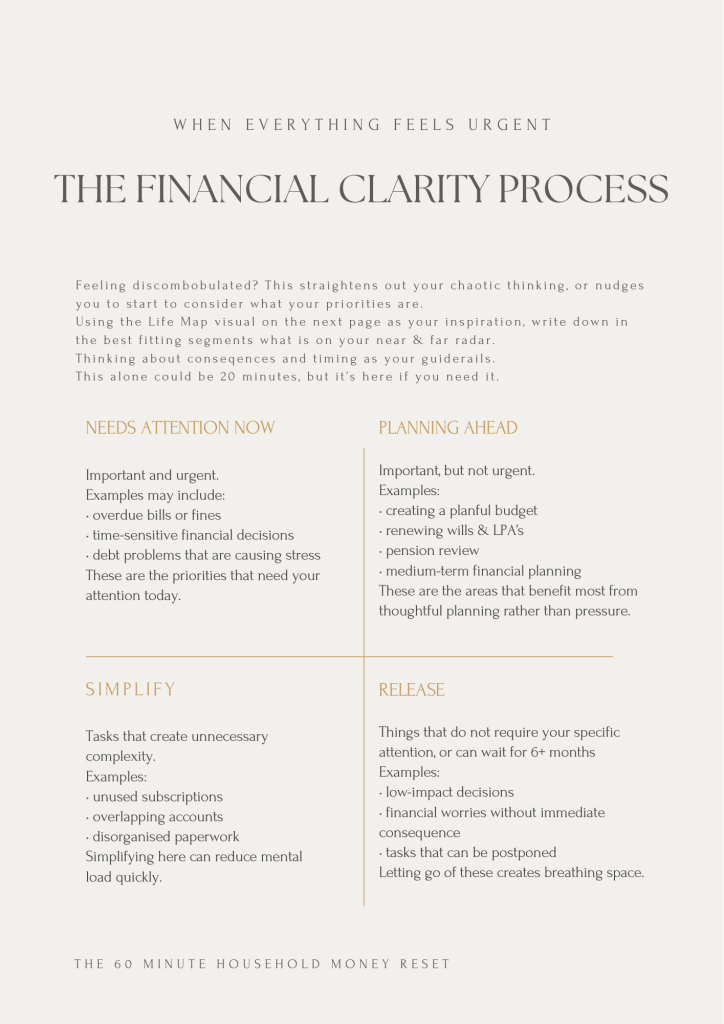
1. Needs Attention Now Things that genuinely need action this week.
2. Planning Ahead Important, but not urgent (next few months).
3. Simplify Things that feel complicated but could be broken down.
4. Release Things that can wait, be delegated, or removed entirely.
This alone can reduce a huge amount of mental pressure.
🌿 Step 2. Layer Your Finances
One of the biggest challenges with money is this; there are so many things you could be doing. And you feel guilty that you’ve not done any of them.
Investing. Saving. Budgeting. Insurance. Pensions. Debt. Mortgage. Car Finance…
It’s noisy. So instead of trying to do everything, or doing nothing because it’s all too much, how about this:
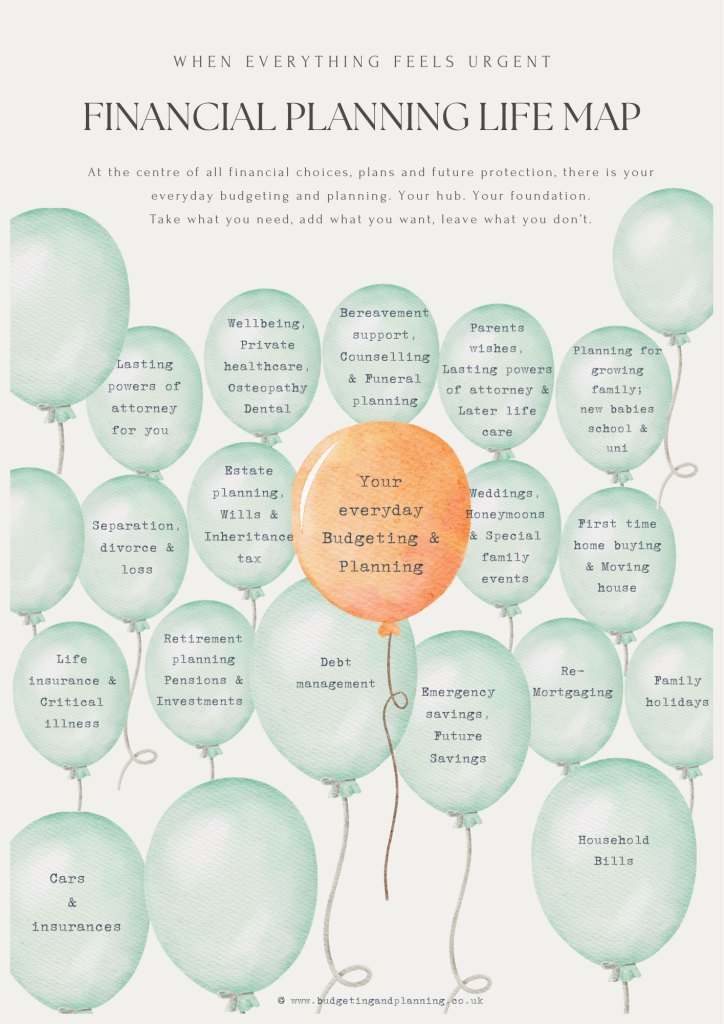
👉 Create a central hub.
Your core focus should be:
Your everyday budgeting and planning. This is your foundation. When this is clear:
• everything else feels less urgent • decisions become easier • the noise quietens
Think of everything else like balloons. You bring one down, deal with it, then let it float away again. You don’t need to hold everything at once.
Layer this into the clarity process so it’s completely personalised to you. Can you feel that fog starting to lift?
🌼 A Gentle Reframe: Values Over Goals
Traditional financial advice often focuses on goals.
But goals can feel rigid. Instead, try asking:
👉 What actually matters to me?
For example:
Do I want to nourish my home & garden this year?
Do I want to protect my family from life’s What If’s better?
If we teamed up to throw all we can at our debt this year, how much lighter will we feel by next Spring?
We need to nurture our relationship so we will have monthly money breakfast dates ☕️ and make lovely lifestyle plans together.
That feels very different to “Sort out life insurance.” Same action. Very different emotional energy.
🌱 Step 3. Create a Simple Financial Routine
This is where everything starts to stick. Because without structure your new routine will quickly fade.
Choose your space
For me, it’s the kitchen table:
• laptop • paperwork • a coffee • maybe a candle and probably some lovely music in the background.
Nothing fancy just a space where I can think clearly, have enough room for any paperwork, diary and large calendar and so it feels like I’m actually taking care of things. It’s not squished into other duties, I’m not doing 3 things at once, it’s peaceful and it feels good.
Keep it simple
The biggest barrier for overthinkers isn’t ability.
It’s faffing. You know it is!!!!
Over-preparing. Over-tweaking. Over-delaying. Or being so unprepared & disorganised that just the thought of getting your things together is all too much before you’ve even started.
So instead:
👉 Set a regular rhythm Weekly, monthly, or seasonal
👉 Gather what you need. Think like a chef on tv who has all the ingredients in gorgeous dishes just waiting to be used. 👉 Work through your process. When it’s written, you don’t need to think. Each task has a checkbox ✅
Done.
If you’ve got the guide downloaded you can move to using that, or see a short version below.
🌿 The Detailed Get It Done Process Now You’re Unstuck With What To Do & When
Here’s a simple structure you can follow for a fresh start. This is brilliantly repeatable each month. Add your own priorities.
1. Gather Your Numbers
Bring together:
• bank accounts • credit cards • savings
The first time may feel messy, that’s normal. You’re not fixing everything. You’re just seeing clearly.
2. Take an Honest Spending Snapshot
Look at:
• where your money is actually going • not where you think it’s going
You might feel:
• pleased • neutral • slightly horrified
All completely normal. This is information not judgement. For goodness sake do NOT go down the rabbit hole of guilt, which is what you’ve DONE. And never go down to shame, which is how you identify your relationship with money. What’s done is done, you are becoming the kind of person who has their financial resources working well.
3. Capture Forgotten Expenses
Those “surprise” costs? They’re often just forgotten ones.
Add things into your calendar like:
• annual bills; car servicing, dentists. • seasonal spending so your garden gets as much love as Christmas, kids after school clubs & new clothes. • renewals so you’re not getting stung on the rollover policies.
This reduces future stress massively.
4. Reset Your Relationship with Credit
Key Q to find the answer to:
• How am I using credit? • Is it intentional? • Is it helping or just happening?
Again, no judgement, just awareness. How do you feel about this? What would you like to be different?
Final Thought
If your finances feel disorganised or stressful…
It’s rarely because you’re bad with money. This isn’t about you as a person, this is about your systems, your process, your habits & routines. These can all be changed. You’re a lovely person, trying your best.
🌿 Your Next Step
If you’d like to follow this process with the practical get it done elements, here’s the link again to download my free Money Reset Guide and work through it at your own pace.
And I’d love to know:
👉 What would you add to your reset? 👉 What feels most overwhelming right now?
With love from
Lucy x
ps. If you are an employer, or HR Manager and would love financial wellbeing education for your team, I freelance with Finwell Training LTD and we would be delighted to welcome you along for a complimentary live masterclass so that you can experience it.
ID used to identify users for 24 hours after last activity
24 hours
_gat
Used to monitor number of Google Analytics server requests when using Google Tag Manager
1 minute
__utmx
Used to determine whether a user is included in an A / B or Multivariate test.
18 months
_ga
ID used to identify users
2 years
_gali
Used by Google Analytics to determine which links on a page are being clicked
30 seconds
_ga_
ID used to identify users
2 years
_gac_
Contains information related to marketing campaigns of the user. These are shared with Google AdWords / Google Ads when the Google Ads and Google Analytics accounts are linked together.
90 days
__utma
ID used to identify users and sessions
2 years after last activity
__utmt
Used to monitor number of Google Analytics server requests
10 minutes
__utmb
Used to distinguish new sessions and visits. This cookie is set when the GA.js javascript library is loaded and there is no existing __utmb cookie. The cookie is updated every time data is sent to the Google Analytics server.
30 minutes after last activity
__utmc
Used only with old Urchin versions of Google Analytics and not with GA.js. Was used to distinguish between new sessions and visits at the end of a session.
End of session (browser)
__utmz
Contains information about the traffic source or campaign that directed user to the website. The cookie is set when the GA.js javascript is loaded and updated when data is sent to the Google Anaytics server
6 months after last activity
__utmv
Contains custom information set by the web developer via the _setCustomVar method in Google Analytics. This cookie is updated every time new data is sent to the Google Analytics server.
2 years after last activity
SourceBuster is used by WooCommerce for order attribution based on user source.
Name
Description
Duration
sbjs_session
The number of page views in this session and the current page path
30 minutes
sbjs_udata
Information about the visitor’s user agent, such as IP, the browser, and the device type
session
sbjs_first
Traffic origin information for the visitor’s first visit to your store (only applicable if the visitor returns before the session expires)
session
sbjs_current
Traffic origin information for the visitor’s current visit to your store
session
sbjs_first_add
Timestamp, referring URL, and entry page for your visitor’s first visit to your store (only applicable if the visitor returns before the session expires)
session
sbjs_current_add
Timestamp, referring URL, and entry page for your visitor’s current visit to your store
session
sbjs_migrations
Technical data to help with migrations between different versions of the tracking feature
session
Marketing cookies are used to follow visitors to websites. The intention is to show ads that are relevant and engaging to the individual user.
Pinterest Tag is a web analytics service that tracks and reports website traffic.
Registers a unique ID to keep statistics of what videos from YouTube the user has seen.
Session
DEVICE_INFO
Used to detect if the visitor has accepted the marketing category in the cookie banner. This cookie is necessary for GDPR-compliance of the website.
179 days
LOGIN_INFO
This cookie is used to play YouTube videos embedded on the website.
2 years
GPS
Registers a unique ID on mobile devices to enable tracking based on geographical GPS location.
1 day
VISITOR_INFO1_LIVE
Tries to estimate the users' bandwidth on pages with integrated YouTube videos. Also used for marketing
179 days
PREF
This cookie stores your preferences and other information, in particular preferred language, how many search results you wish to be shown on your page, and whether or not you wish to have Google’s SafeSearch filter turned on.






Recent Comments